Firm-Level Determinants of Sustainability Practices in the UK Banking Sector: A Stakeholder Perspective
DOI:
https://doi.org/10.47453/ecobankers.v6i1.3213Keywords:
Sustainability practices, UK banking sector, stakeholder perspective, firm-level determinants, customer demand, sustainability disclosuresAbstract
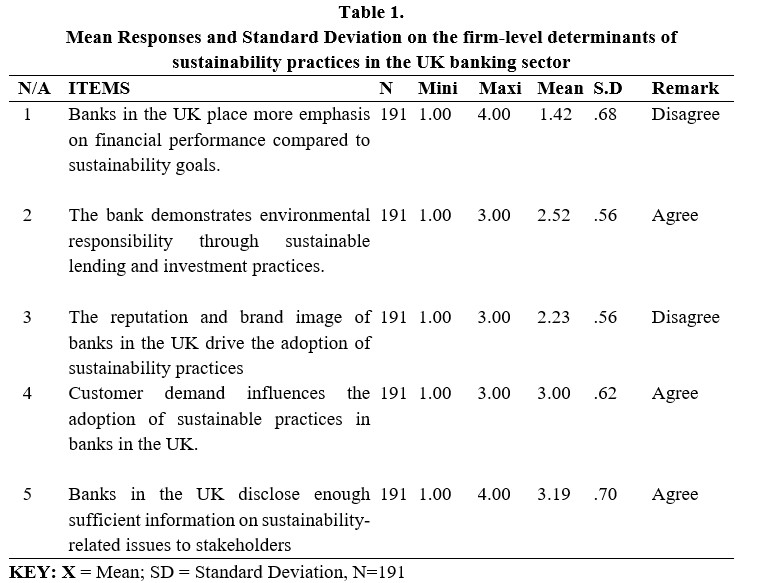
The primary objective of this study was to understand the key factors that influence the adoption of sustainability practices within banks, focusing on firm-level factors. The research employed an online survey targeting stakeholders in the UK banking sector, using structured questions to assess perceptions of sustainability practices and their alignment with financial goals. The findings revealed that, while UK banks are increasingly adopting sustainable lending and investment practices, there remains a stronger emphasis on financial performance over sustainability goals. Banks often prioritize their reputation and brand image, with customer demand playing a significant role in shaping sustainability practices. Furthermore, the study found that banks in the UK provide sufficient sustainability-related disclosures to stakeholders, meeting growing expectations for transparency. In conclusion, the study emphasizes the need for UK banks to integrate sustainability into their core strategies, balancing financial performance with environmental and social goals. The research recommends that banks strengthen their commitment to sustainability by aligning their operations more closely with stakeholder expectations and enhancing sustainability reporting practices. Additionally, policymakers should consider incentivizing sustainability practices to further promote environmental responsibility within the banking sector.
Downloads
References
Aguilera, R. V., & Crespi-Cladera, R. (2016). Global corporate governance: On the relevance of firms’ ownership structure. Journal of World Business, 51(1), 50-57.
Cantele, S., & Zardini, A. (2018). Is sustainability a competitive advantage for small businesses? An empirical analysis of possible mediators in the sustainability–financial performance relationship. Journal of cleaner production, 182, 166-176.
Costa-Climent, R., & Martínez-Climent, C. (2018). Sustainable profitability of ethical and conventional banking. Contemporary Economics, 12(4), 519-530.
Duc Cuong Pham, Thi Ngoc Anh Do, Thanh Nga Doan, Thi Xuan Hong Nguyen &Thi Kim Yen Pham | (2021) The impact of sustainability practices on financial performance: empirical evidence from Sweden, Cogent Business & Management, 8:1, 1912526, DOI: 10.1080/23311975.2021.1912526
Fang, L., Shi, S., Gao, J., & Li, X. (2022). The mediating role of green innovation and green culture in the relationship between green human resource management and environmental performance. Plos one, 17(9), e0274820.
Feridun, M., & Güngör, H. (2020). Climate-related prudential risks in the banking sector: A review of the emerging regulatory and supervisory practices. Sustainability, 12(13), 5325.
Ghoul, S. E., Guedhami, O., & Kim, Y. (2017). Country-level institutions, firm value, and the role of corporate social responsibility initiatives. Journal of International Business Studies, 48, 360-385.
Haji, M., and Himpel, F. (2024) Building Resilience in Food Security: Sustainable Strategies Post-COVID-19. Sustainability, 16(3), p.995.
Kutaula, S., Chowdhury, S., Gillani, A., Budhwar, P. S., & Dey, P. K. (2025). Linking HRM with sustainability performance through sustainability practices: Unlocking the black box. British Journal of Management, 36(2), 615-632.
Luo, J., Zaman, S. I., Jamil, S., & Khan, S. A. (2025). The future of healthcare: green transformational leadership and GHRM’s role in sustainable performance. Benchmarking: An International Journal, 32(3), 805-837.
Maina, J. (2023). The Impact of Changes in the Capital Structure on the Financial Performance of UK Commercial Banks: Case of Lloyds Bank, HSBC Bank and Barclays Bank. European Academic Journal-I, 2(001).
Naciti, V. (2019). Corporate governance and board of directors: The effect of a board composition on firm sustainability performance. Journal of cleaner production, 237, 117727.
Sikder, A. S., Ahmed, S., & Islam, J. (2023). Leveraging Information Technology for Green IT and Sustainable Development: An Analysis of Environmental Sustainability, Energy Efficiency, and Carbon Footprint Reduction Initiatives.: IT for Green IT and Sustainable Development. International Journal of Imminent Science & Technology., 1(1), 48-63.
Downloads
Published
How to Cite
Issue
Section
License
Copyright (c) 2025 Authors

This work is licensed under a Creative Commons Attribution 4.0 International License.