Exploring the Cognitive and Social Benefits of Bubble Blowing Activities in Early Childhood Development: A Thought Experiment Approach
DOI:
https://doi.org/10.47453/hadlonah.v6i1.3109Keywords:
Bubble Blowing, Early Childhood Development, Play-Based Learning, Cognitive Skills, Social-Emotional GrowthAbstract
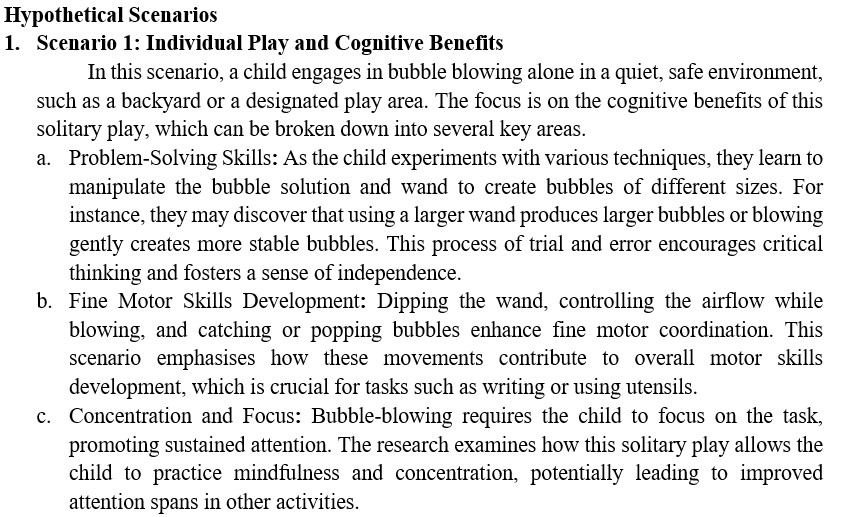
Play is universally recognised as a vital aspect of early childhood development, yet specific activities, such as bubble blowing, remain underexplored in the literature. This research investigates bubble-blowing's cognitive, social, and emotional impacts on young children, providing empirical evidence to support integrating such activities into early childhood curricula. Utilising a thought-experimental approach, the study engaged educators and parents in reflective discussions about children's experiences and observations during bubble-blowing activities. The findings reveal that bubble blowing significantly enhances cognitive skills, including problem-solving and critical thinking, as children explore scientific concepts through hands-on experimentation. Socially, the activity fosters collaboration, communication, and conflict resolution, demonstrating that structured and unstructured play can yield substantial social benefits. Emotionally, children express various feelings, from joy to frustration, contributing to their emotional regulation and resilience. In conclusion, bubble blowing is an effective tool for promoting holistic development in early childhood. This research contributes to the existing body of literature by providing specific insights into the developmental benefits of targeted play activity, emphasising the need for educators and parents to prioritise play-based learning. By highlighting the multifaceted advantages of bubble-blowing, the study advocates for its inclusion in educational settings, ultimately enhancing the quality of early childhood education and fostering well-rounded development in young children.
Downloads
References
Asik-Ozturk, M., Ahmetoglu, E., & Acar, I. H. (2021). The contributions of children’s social competence, aggression, and anxiety to their play behaviours with peers. Early Child Development and Care. https://doi.org/10.1080/03004430.2019.1614570
Beloglovsky, M. (2023). Just play: Inspiring adult play in early childhood education. Redleaf Press.
Bohling, K., Tankelevitch, L., Vinnitchok, A., Barnard, M., Anders, J., Shure, N., & Wyse, D. (2021). Speech Bubbles. Evaluation Report. Education Endowment Foundation.
Brown, A. L., Metz, K. E., & Campione, J. C. (2013). Social interaction and individual understanding in a community of learners: The influence of Piaget and Vygotsky. In Piaget Vygotsky (pp. 145-170). Psychology Press.
Brown, S. L., McCobin, A., Easley, S., & McGoey, K. E. (2020). Supporting anxious children in the preschool classroom. YC Young Children, 75(3), 16–27.
Burns-Nader, S., & Hernandez-Reif, M. (2016). Facilitating play for hospitalised children through child life services. Children's health care, 45(1), 1-21. https://doi.org/10.1080/02739615.2014.948161
Chatterjee, S. (2018). Children's coping, adaptation and resilience through play in situations of crisis. Children, Youth and Environments, 28(2), 119–145. https://doi.org/10.1353/cye.2018.0015
Doebel, S., & Lillard, A. S. (2023). How does play foster development? A new executive function perspective. Developmental Review, 67, 101064. https://doi.org/10.1016/j.dr.2022.101064
El Zaatari, W., & Maalouf, I. (2022). How does the Bronfenbrenner bio-ecological system theory explain the development of students’ sense of belonging to school? Sage Open, 12(4), 21582440221134089. https://doi.org/10.1177/21582440221134089
Giménez-Dasí, M., Quintanilla, L., & Daniel, M. F. (2013). Improving emotion comprehension and social skills in early childhood through philosophy for children. Childhood & Philosophy, 9(17), 63-89.
Goldman, S., Solano-Altamirano, M., & Ledez, K. (2017). Gas Bubble Dynamics in the Human Body. Academic Press. https://doi.org/10.22462/01.02.2018.15
Grant, R. J. (2019). Play therapy for children with autism spectrum disorder. Prescriptive play therapy: Tailoring interventions for specific childhood problems, 213.
Hakimovna, R. M. (2024). Promoting Cognitive Growth In Young Children Through Preschool Education. Western European Journal of Linguistics and Education, 2(11), 172-175.
Iruka, I. U., DeKraai, M., Walther, J., Sheridan, S. M., & Abdel-Monem, T. (2020). Examining how rural ecological contexts influence children’s early learning opportunities. Early Childhood Research Quarterly, 52, 15-29. https://doi.org/10.1016/j.ecresq.2019.09.005
Jacobs, B. (2022). Self-regulation and inquiry-based learning in the primary classroom. Canadian Scholars’ Press.
Kaizar, V. O., & Alordiah, C. O. (2023). Understanding the role of play in promoting cognitive, social, and emotional development in school children: implications for counsellors and evaluators. University of Delta Journal of Contemporary Studies in Education, 2(1), 138-52.
Kalkusch, I., Jaggy, A. K., Burkhardt Bossi, C., Weiss, B., Sticca, F., & Perren, S. (2022). Fostering children’s social pretend play competence and social skills through play tutoring: What is the mechanism of change? International Journal of Behavioral Development, 46(5), 461-471. https://doi.org/10.1177/01650254221108163
Kandemir, M. (2020). Outdoor time practices in early childhood education: parent and teacher views (Master's thesis, Middle East Technical University (Turkey)).
Kazemeini, T., & Pajoheshgar, M. (2013). Children’s play in the context of culture: Parental Ethnotheories. Journal of Science and Today’s World, 2(3), 265-281.
Levine, J. (2012). 365 Toddler Activities That Inspire Creativity: Games, Projects, and Pastimes That Encourage a Child's Learning and Imagination. Simon and Schuster.
Lin, C. Y., Chen, W. J., & Lin, C. C. (2017, July). The effects of interactive music and bubble feedback using Arduino on enhancing physical activities for children with cerebral palsy. In Proceedings of the 1st International Conference on Education and Multimedia Technology (pp. 1–7). https://doi.org/10.1145/3124116.3124117
Loop, L., Mouton, B., Brassart, E., & Roskam, I. (2017). The observation of child behaviour during parent-child interaction: The psychometric properties of the Crowell Procedure. Journal of Child and Family Studies, 26, 1040-1050. https://doi.org/10.1007/s10826-016-0625-0
Moore, J. (2021). Developing secure attachment through play: Helping vulnerable children build their social and emotional wellbeing. Routledge. https://doi.org/10.4324/9781003150176
Morgan, L., & Howard, J. (2014). Using play therapeutically with children in a hospital setting. In Play Therapy Today (pp. 47–63). Routledge. https://doi.org/10.4324/9780203740286-4
Pakpahan, F. H., & Saragih, M. (2022). Theory of cognitive development by Jean Piaget. Journal of Applied Linguistics, 2(1), 55-60. https://doi.org/10.52622/joal.v2i2.79
Pardjono, P. (2016). Active learning: The Dewey, Piaget, Vygotsky, and constructivist theory perspectives. Jurnal Ilmu Pendidikan Universitas Negeri Malang, 9(3), 105376.
Pearson, L. (2019). What does it mean to be resilient? The use of drama and child-centred play therapy to foster resilience in children (Doctoral dissertation, Concordia University).
Qayyum, A., Fatima, R., & Iram, A. (2024). Play-Based Learning and Child Cognitive-Emotional Development in Nature-Based Programs. Annals of Human and Social Sciences, 5(4), 348-365. https://doi.org/10.35484/ahss.2024(5-IV)33
Rais, R., & Al Haddar, G. (2024). Assessing the Impact of Early Childhood Education Programs on Cognitive, Social, and Emotional Development: A Quasi-Experimental Study. Jurnal Ilmu Pendidikan dan Humaniora, 13(3), 152-166.
Savina, E. (2014). Does play promote self-regulation in children? Early Child Development and Care, 184(11), 1692-1705. https://doi.org/10.1080/03004430.2013.875541
Shernoff, D. J. (2024). Integrative STEM and STEAM Education for Real-Life Learning. Springer Nature. https://doi.org/10.1007/978-3-031-69824-8
Silalahi, R. M. (2019). Understanding Vygotsky’s zone of proximal development for learning. Polyglot: Jurnal Ilmiah, 15(2), 169-186. https://doi.org/10.19166/pji.v15i2.1544
Smith, S., & Pereira, J. (2019). Getting Creative: Using Play and Expressive Arts. In Counseling at the Beginning (pp. 168-194). Routledge. https://doi.org/10.4324/9781315651934-8
Souers, K., & Hall, P. (2016). Fostering resilient learners: Strategies for creating a trauma-sensitive classroom. ASCD.
Stolz, S. (2014). The philosophy of physical education: A new perspective. Routledge. https://doi.org/10.4324/9781315762258
Sutama, I. W., Anisa, N., & Astuti, W. (2021, November). Improving higher-order thinking skills through the implementation of open-ended play for children aged 5-6 years. In 7th International Conference on Education and Technology (ICET 2021) (pp. 97-104). Atlantis Press.
Swank, J. M., & Shin, S. M. (2015). Nature-based child-centred play therapy: An innovative counselling approach. International Journal of Play Therapy, 24(3), 151. https://doi.org/10.1037/a0039127
Swargiary, K. (2024). Language and learning: The crucial role of language in the teaching-learning process. Google.
Ungar, M., Ghazinour, M., & Richter, J. (2013). Annual research review: What is resilience within the social ecology of human development? Journal of child psychology and psychiatry, 54(4), 348–366. https://doi.org/10.1111/jcpp.12025
Waite-Stupiansky, S. (2022). Jean Piaget's constructivist theory of learning. In Theories of early childhood education (pp. 3–18). Routledge. https://doi.org/10.4324/9781003288077-2
Walker, G., & Venker Weidenbenner, J. (2019). Social and Emotional Learning in the age of virtual play: technology, empathy, and learning. Journal of Research in Innovative Teaching & Learning, 12(2), 116-132. https://doi.org/10.1108/JRIT-03-2019-0046
Whitebread, D. (2015). Introduction: Young children learning and early years teaching. In Teaching and learning in the early years (pp. 1–22). Routledge. https://doi.org/10.4324/9781315858234-1
Wood, B. E., Taylor, R., Atkins, R., & Johnston, M. (2018). Pedagogies for active citizenship: Learning through affective and cognitive domains for deeper democratic engagement. Teaching and Teacher Education, 75, 259-267. https://doi.org/10.1016/j.tate.2018.07.007
Wood, E. A. (2013). Play, Learning and the Early Childhood Curriculum: SAGE Publications.
Wynberg, E. R., Boland, A., Raijmakers, M. E., & van der Veen, C. (2022). Towards a comprehensive view of object-oriented play. Educational Psychology Review, 34(1), 197-228. https://doi.org/10.1007/s10648-021-09608-7
Zhou, Y., & Tolmie, A. (2024). Associations between gross and fine motor skills, physical activity, executive function, and academic achievement: longitudinal findings from the UK millennium Cohort Study. Brain Sciences, 14(2), 121. https://doi.org/10.3390/brainsci14020121
Additional Files
Published
Issue
Section
License
Copyright (c) 2025 Authors

This work is licensed under a Creative Commons Attribution 4.0 International License.