Preparing Pre-service Teachers for STEAM with Islamic Values: A Multi-Case Study of Indonesian Early Childhood Education Programmes
Keywords:
STEAM education, early childhood education, pre-service teacher readiness, islamic values integration, indonesia, teacher educationAbstract
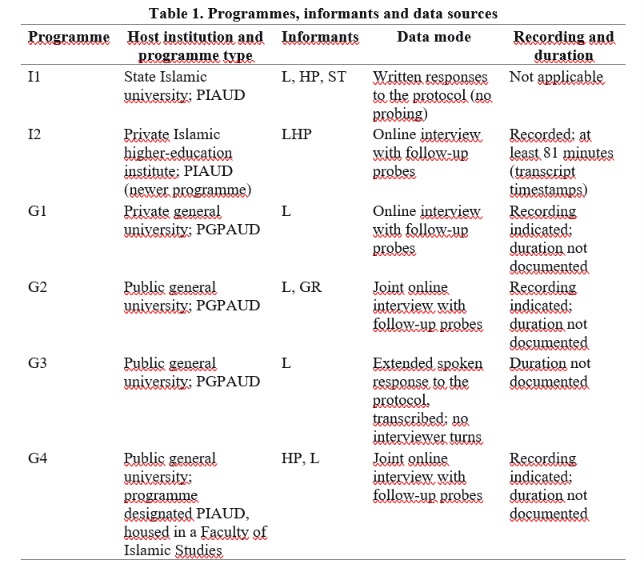
This study investigated the readiness and preparation of pre-service early childhood teachers in Indonesia to implement STEAM programs integrated with Islamic values. Employing a qualitative multi-case design, semi-structured interviews were conducted with six lecturers, three heads of study programmes, and one recent graduate across six higher education institutions, three Islamic (PIAUD) and three public (PGPAUD). Thematic analysis identified four overarching themes: readiness and preparation, constraints and facilitators, improvement plans, and Islamic values integration. Findings revealed a pervasive theory, practice gap; pre-service teachers demonstrated conceptual understanding of STEAM but lacked the integrated, child-centred pedagogical competence required for classroom practice. Key constraints included fragmented curricula with no dedicated STEAM or engineering courses, a narrow definition of technology, lecturer background mismatches, and underutilized school partnerships. Islamic universities operated under explicit mandates to integrate Qur’anic and Hadith foundations, while public institutions had no such policy; nonetheless, personal support for values integration was universal across all informants. Proposed reforms centred on curriculum integration, expanded and verified practicum placements, and faculty professional development in STEAM pedagogy. A critical perception gap emerged between lecturers’ accounts of systematic Islamic integration and the student’s experience of its absence in practice. The study offers actionable recommendations for strengthening teacher education and demonstrates the feasibility, and wide endorsement, of embedding religious and moral values within STEAM preparation in a national context where character and science learning are both policy imperatives.
Downloads
References
Abdullah, M. A. (2014). Religion, science and culture: An integrated, interconnected paradigm of science. Al-Jami’ah: Journal of Islamic Studies, 52(1), 175–203. https://doi.org/10.14421/ajis.2014.521.175-203
Angelone, L. (2020). STEAM in early childhood education: A blended module to investigate preservice teachers’ conceptualizations of STEAM education. Ohio Journal of Teacher Education, 34(1), Article 5. https://www.exhibit.xavier.edu/ojte/vol34/iss1/5/
Braun, V., & Clarke, V. (2006). Using thematic analysis in psychology. Qualitative Research in Psychology, 3(2), 77–101. https://doi.org/10.1191/1478088706qp063oa
Braun, V., & Clarke, V. (2021). One size fits all? What counts as quality practice in (reflexive) thematic analysis? Qualitative Research in Psychology, 18(3), 328–352. https://doi.org/10.1080/14780887.2020.1769238
Brusic, S., Marcum-Dietrich, N., Shettel, J., & White, J. (2023). Building a firm foundation: Preparing Pre-K–4 teachers for integrative STEM pedagogy. Innovations in Science Teacher Education, 8(1). https://innovations.theaste.org/index.php/iste/article/view/383
Cohrssen, C., Guarrella, C., Hebden, K., Quinn, F., & Nirmalathas, A. (2025). Situating engineering within the Australian pre-tertiary education system. The Australian Educational Researcher, 52(6). https://doi.org/10.1007/s13384-025-00880-y
Direktorat Jenderal Pendidikan Islam. (2019). Keputusan Direktur Jenderal Pendidikan Islam Nomor 2498 Tahun 2019 tentang pedoman implementasi integrasi ilmu di perguruan tinggi keagamaan Islam [Decree of the Director General of Islamic Education No. 2498 of 2019 on guidelines for implementing the integration of knowledge in Islamic higher education institutions]. Kementerian Agama Republik Indonesia.
Dong, C., & Mertala, P. (2021). It is a tool, but not a ‘must’: Early childhood preservice teachers’ perceptions of ICT and its affordances. Early Years, 41(5), 540–555. https://doi.org/10.1080/09575146.2019.1627293
Drupadi, R., & Zain, A. (2025). Exploring early childhood education teacher’s beliefs about STEAM learning in Indonesia. Southeast Asia Early Childhood Journal, 14(1), 93–105. https://doi.org/10.37134/saecj.vol14.1.7.2025
Eliasson, S., Peterson, L., & Lantz-Andersson, A. (2023). A systematic literature review of empirical research on technology education in early childhood education. International Journal of Technology and Design Education, 33(3), 793–818. https://doi.org/10.1007/s10798-022-09764-z
English, L. D. (2016). STEM education K-12: Perspectives on integration. International Journal of STEM Education, 3, Article 3. https://doi.org/10.1186/s40594-016-0036-1
Evagorou, M. (2024). Engaging kindergarten pre-service teachers in the design and implementation of STEM lessons. Frontiers in Education, 9, 1277835. https://doi.org/10.3389/feduc.2024.1277835
Fatwikiningsih, N., & Ismaeil, N. (2025). Enhancing early childhood teacher pedagogical competence through STEAM-based instructional training: An experimental study. Indonesian Journal of Early Childhood Educational Research, 4(1). https://doi.org/10.31958/ijecer.v4i1.14982
Kay, L., Putri, S., Dewi, F., Buxton, A., & Buyani, T. (2025). STEAM-ECE: Developing a STEAM approach for early childhood education in Indonesia. Indonesian Journal of Early Childhood Education Studies, 14(2), 103–115. https://doi.org/10.15294/ijeces.v14i2.33363
Kementerian Pendidikan Dasar dan Menengah. (2025). Peraturan Menteri Pendidikan Dasar dan Menengah Nomor 13 Tahun 2025 tentang perubahan atas Peraturan Menteri Pendidikan, Kebudayaan, Riset, dan Teknologi Nomor 12 Tahun 2024 tentang kurikulum pada pendidikan anak usia dini, jenjang pendidikan dasar, dan jenjang pendidikan menengah [Regulation No. 13 of 2025 amending the regulation on the curriculum for early childhood, primary and secondary education].
Kementerian Pendidikan, Kebudayaan, Riset, dan Teknologi. (2022). Keputusan Menteri Pendidikan, Kebudayaan, Riset, dan Teknologi Nomor 56/M/2022 tentang pedoman penerapan kurikulum dalam rangka pemulihan pembelajaran [Decree No. 56/M/2022 on guidelines for curriculum implementation for learning recovery].
Kementerian Pendidikan, Kebudayaan, Riset, dan Teknologi. (2024). Peraturan Menteri Pendidikan, Kebudayaan, Riset, dan Teknologi Nomor 12 Tahun 2024 tentang kurikulum pada pendidikan anak usia dini, jenjang pendidikan dasar, dan jenjang pendidikan menengah [Regulation No. 12 of 2024 on the curriculum for early childhood, primary and secondary education].
Lincoln, Y. S., & Guba, E. G. (1985). Naturalistic inquiry. Sage.
Machmud, H., Abidin, A., Alim, N., & Rasmi. (2025). Bridging knowledge and practice: Evidence from pre-service early childhood teachers’ PCK implementation in their teaching practicum. Journal of Early Childhood Teacher Education. Advance online publication. https://doi.org/10.1080/10901027.2025.2565691
Miles, M. B., Huberman, A. M., & Saldaña, J. (2020). Qualitative data analysis: A methods sourcebook (4th ed.). Sage.
Nadlifah, & Latif, M. A. (2024). Creative freedom and holistic growth: Implementation of the STEAM approach in Islamic early childhood education. Golden Age: Jurnal Ilmiah Tumbuh Kembang Anak Usia Dini, 9(4), 689–702. https://doi.org/10.14421/jga.2024.94-09
Nugraha, M. G., Kidman, G., & Tan, H. (2023). Pre-service teacher in STEM education: An integrative review and mapping of the Indonesian research literature. EURASIA Journal of Mathematics, Science and Technology Education, 19(5), em2262. https://doi.org/10.29333/ejmste/13155