Deep Learning-Based STEM Learning Model To Improve Early Childhood Science Literacy
Keywords:
STEM, Deep Learning, Science Literacy, Early ChildhoodAbstract
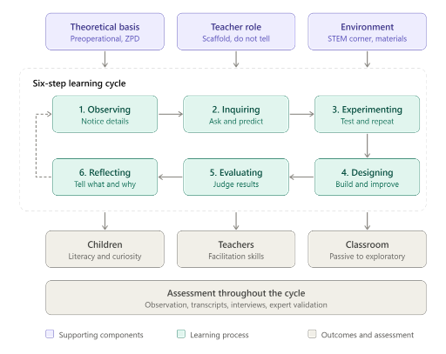
This research aims to develop and implement a deep learning-based STEM learning model to enhance early childhood science literacy. The study is motivated by children's limited understanding of basic scientific concepts, insufficient opportunities for exploration in early childhood classrooms, and the continued use of teacher-centered instructional methods that restrict active learning and critical thinking. The proposed model integrates deep learning principles through observation, exploration, experimentation, discussion, and reflection, enabling children to construct scientific understanding actively and meaningfully. This research employed a qualitative Research and Development (R&D) approach involving teachers, children aged 5–6 years, and school principals. Data were collected through classroom observations, interviews, documentation, and field notes and analyzed using thematic analysis. The findings indicate that the developed model significantly improves children's ability to explain scientific phenomena, make predictions, formulate questions, and understand simple cause-and-effect relationships. Children also demonstrate increased curiosity, confidence in conducting experiments, and communication skills when presenting their findings. In addition, teachers enhance their competence in facilitating inquiry-based and experiment-oriented learning. A well-designed learning environment further supports meaningful learning experiences. Overall, the deep learning-based STEM learning model is feasible, practical, and effective in strengthening early childhood science literacy and provides an innovative instructional alternative for early childhood education settings.
Downloads
References
Afif, N., Ayuningrum, D., Imran, A., & Qowim, A. N. (2022). Inovasi pengembangan kurikulum dengan pendekatan saintifik untuk RA/PAUD di Provinsi Banten. Edukasi Islami: Jurnal Pendidikan Islam, 11(1), 79–102.
Anggraini, H., Haryono, S. E., Muntomimah, S., Wijayanti, R., & Akbar, M. R. (2022). Strategi pengembangan Kurikulum Merdeka Belajar Kampus Merdeka berbasis individual differences. Jurnal Ilmiah Potensia, 7(1), 64–74. https://doi.org/10.33369/jip.7.1.64-74
Aslina, Y., & Hidayah, L. (2025). Implementasi Kurikulum Merdeka dalam peningkatan pembelajaran di PAUD melalui pendekatan PDIA. Murhum: Jurnal Pendidikan Anak Usia Dini, 6(2).
Ayuningsih, F., Malikah, S., Nugroho, M. R., Winarti, W., Murtiyasa, B., & Sumardi, S. (2022). Pembelajaran matematika polinomial berbasis STEAM PjBL menumbuhkan kreativitas peserta didik. Jurnal Basicedu, 6(5), 8175–8187. https://doi.org/10.31004/basicedu.v6i5.3660
Azizah, E. M., Yuhasriati, Y., Khoiriyah, K., Rosmiati, R., & Mandira, G. (2023). Implementasi pembelajaran berbasis STEAM dalam mengembangkan kreativitas anak usia dini. Jurnal Obsesi: Jurnal Pendidikan Anak Usia Dini, 7(6), 6620–6630.
Bae, C. L., Shavlik, M., Shatrowsky, C., Haden, C. A., & Booth, A. E. (2023). Predicting grade school scientific literacy from aspects of the early home science environment. Frontiers in Psychology, 14.
Basyir, M. S., Dinana, A., & Devi, A. D. (2022). Kontribusi teori belajar kognitivisme David P. Ausubel dan Robert M. Gagne dalam proses pembelajaran. Jurnal Pendidikan Madrasah, 7(1), 89–100. https://doi.org/10.14421/jpm.2022.71.12
Campos, V. M., & Muñoz, F. J. R. (2023). Design and piloting of a proposal for intervention with educational robotics for the development of lexical relationships in early childhood education. Smart Learning Environments, 10(1), 1–13.
Canbeldek, M., & Isikoglu, N. (2022). Exploring the effects of a coding and robotics education program on kindergartners' creativity. Education and Information Technologies.
Cankaya, O., Rohatyn-Martin, N., Leach, J., Taylor, K., & Bulut, O. (2023). Preschool children's loose parts play and the relationship to cognitive development: A review of the literature. Journal of Intelligence, 11(8), 151–169. https://doi.org/10.3390/jintelligence11080151
Chen, Y. L., Huang, L. F., & Wu, P. C. (2021). Preservice preschool teachers' self-efficacy in and need for STEM education professional development: STEM pedagogical belief as a mediator. Early Childhood Education Journal, 49, 137–147. https://doi.org/10.1007/s10643-020-01055-3
Dewi, P. Y. P., Asril, N. M., & Handayani, D. A. P. (2021). Video pembelajaran gerak dan lagu untuk menstimulasi kemampuan lokomotor anak usia 5–6 tahun. Jurnal Pendidikan Anak Usia Dini, 9(1), 32–42.
Fitri, D. A. N., & Suryana, D. (2022). Pembelajaran STEAM dalam mengembangkan kemampuan kreativitas anak usia dini. Jurnal Pendidikan Tambusai, 6(2), 12544–12552.
Fitrianingtyas, A., Wahyuningsih, S., Rasmani, U. E. E., Winarji, B., Jumiatmoko, J., Nurjanah, N. E., & Zuhro, N. S. (2025). Evaluasi implementasi Kurikulum Merdeka di lembaga Pendidikan Anak Usia Dini. Murhum: Jurnal Pendidikan Anak Usia Dini, 6(1).
Fraenkel, J. R., Wallen, N. E., & Hyun, H. H. (2022). How to design and evaluate research in education (10th ed.). McGraw-Hill Education.
Ghanad, A. (2023). An overview of quantitative research methods. International Journal of Multidisciplinary Research and Analysis, 6(8), 3794–3803. https://doi.org/10.47191/ijmra/v6-i8-52
Gul, Y. E. (2023). A theoretical perspective on survey method from quantitative research methods. Universum: Psikhologiya i Obrazovanie, 4(106), 64–68. https://doi.org/10.32743/UniPsy.2023.106.4.15254
Hair, J. F., Hult, G. T. M., Ringle, C. M., & Sarstedt, M. (2021). A primer on partial least squares structural equation modeling (PLS-SEM) (3rd ed.). SAGE Publications.
Irdalisa, I., Amirullah, G., & Dirza, A. F. (2022). Pelatihan pengembangan perangkat pembelajaran berbasis STEAM bagi guru IPA. JMM (Jurnal Masyarakat Mandiri), 6(2), 1393–1401. https://doi.org/10.31537/dedication.v6i2.817
Irdalisa, I., Elvianasti, M., Maesaroh, M., Yarza, H. N., & Fuadi, T. M. (2021). Improving student's curiosity by ICT-assisted guided inquiry models. Al-Ishlah: Jurnal Pendidikan, 13(1), 156–163. https://doi.org/10.35445/alishlah.v13i1.402
Iwasaki, S., Moriguchi, Y., & Sekiyama, K. (2023). Parental responsiveness and children's trait epistemic curiosity. Frontiers in Psychology, 13, Article 1075489. https://doi.org/10.3389/fpsyg.2022.1075489
Karnani, R., Sharma, M., & Verma, M. (2023). Understanding the influence of parental involvement on science learning task completion. Multidisciplinary Science Journal, 5, Article 2023ss0211.
Komari, & Aslan. (2025). Menggali potensi optimal anak usia dini. Jurnal Ilmiah Edukatif, 11(1), 68–78.
Kurniawan, H., Pratiwi, R., & Susilo, A. (2022). Zone of proximal development and scaffolding in early childhood learning. Jurnal Ilmu Pendidikan, 29(1), 12–24. https://doi.org/10.17977/jip.v29i1.2022
Leung, W. M. V. (2023). STEM education in early years: Challenges and opportunities in changing teachers' pedagogical strategies. Education Sciences, 13(5), 490. https://doi.org/10.3390/educsci13050490
Li, Y., & Xiao, Y. (2022). Authorship and topic trends in STEM education research. International Journal of STEM Education, 9(1). https://doi.org/10.1186/s40594-022-00378-4
Lestari, M. (2024). Implementasi Kurikulum Merdeka di Pendidikan Anak Usia Dini (PAUD): Tinjauan kritis dari perspektif guru. Pernik, 7(1), 43–51. https://doi.org/10.31851/pernik.v7i1.15582
Lestari, M., Setiawan, D., & Wahyono, P. (2023). Effect of active learning models on cognitive development of children aged 4–6 years. Jurnal Pendidikan Anak Usia Dini, 7(3), 198–211. https://doi.org/10.21009/jpud.073.12
Lin, X., Yang, W., Xie, W., & Li, H. (2023). The integrative role of parenting styles and parental involvement in young children's science problem-solving skills. Frontiers in Psychology, 14, Article 1096846. https://doi.org/10.3389/fpsyg.2023.1096846
Liu, Y., & Pásztor, A. (2022). Effects of problem-based learning instructional intervention on critical thinking in higher education: A meta-analysis. Thinking Skills and Creativity, 45, 1–21. https://doi.org/10.1016/j.tsc.2022.101069
Machali, I. (2022). Bagaimana melakukan penelitian tindakan kelas bagi guru. IJAR, 1(2), 12–21. https://doi.org/10.14421/ijar.2022.12-21
Mahama, I., Yusuf Dramanu, B., & Asamoah-Gyimah, K. (2023). Predictive abilities of curiosity, creativity, and motivation on academic performance of high school students in Ghana. Education Research International, 2023, 1–10. https://doi.org/10.1155/2023/4626945
Maharani, A., Pratama, B., & Indah, C. (2023). Cognitive development of preschool children at the preoperational stage: Implications for ECE learning. Jurnal Pendidikan Dasar Nusantara, 9(1), 71–84. https://doi.org/10.29407/jpdn.v9i1.2023
Mardhani, S. D. T., Haryanto, Z., & Hakim, A. (2022). Penerapan model problem based learning untuk meningkatkan keterampilan berpikir kritis siswa SMA. EduFisika: Jurnal Pendidikan Fisika, 7(2), 206–213.
Mardiyah, F., & Santoso, G. (2025). Exploration and collaboration-based learning strategies for optimal cognitive development in early childhood. Jurnal Pendidikan dan Kebudayaan, 10(1), 15–29.
Martinez, R., & Chen, L. (2022). Use of interactive flat panel towards conceptual understanding. Journal of Interactive Learning Research, 33(1), 55–78.
McNeill, L., & Fitch, D. (2023). Microlearning through the lens of Gagné's nine events of instruction: A qualitative study. TechTrends, 67(3), 521–533. https://doi.org/10.1007/s11528-022-00805-x
Movahedazarhouligh, S., Kermani, H., & Aldemir, J. (2023). STEM integrated curriculums in early childhood education: An exploration of teachers' pedagogical beliefs and practices. International Journal of Modern Education Studies, 7(2), 106–127.
Mulyasa, H. E., & Hernawati, T. (2023). Effectiveness of constructivist approaches in improving cognitive abilities of children aged 4–6 years. Jurnal Obsesi: Jurnal Pendidikan Anak Usia Dini, 7(1), 213–226. https://doi.org/10.31004/obsesi.v7i1.3201
Munawar, M. (2022). Penguatan komite pembelajaran dalam implementasi Kurikulum Merdeka pada Pendidikan Anak Usia Dini. Tinta Emas: Jurnal Pendidikan Islam Anak Usia Dini, 1(1), 65–72. https://doi.org/10.35878/tintaemas.v1i1.390
Naeem, M., Ozuem, W., Howell, K., & Ranfagni, S. (2023). A step-by-step process of thematic analysis to develop a conceptual model in qualitative research. International Journal of Qualitative Methods, 22.
Nofitasari, N., Liftiah, L., & Mulawarman, M. (2023). Kurikulum Merdeka di sekolah ramah anak berbasis Islam dan bilingual. Jurnal Obsesi: Jurnal Pendidikan Anak Usia Dini, 7(5), 5895–5906. https://doi.org/10.31004/obsesi.v7i5.5261
Noer Ashfarina, I., & Tri Wijayati, D. W. (2023). Implementasi Kurikulum Merdeka Belajar di Pendidikan Anak Usia Dini (PAUD). Edukasia: Jurnal Pendidikan dan Pembelajaran, 4(2), 1355–1364.
Nugroho, S., & Amalia, R. (2022). Meaningful learning and its effect on early childhood thinking abilities. Jurnal Pendidikan dan Pembelajaran, 5(2), 34–47. https://doi.org/10.26858/jpp.v5i2.2022
Nurhayati, S. (2021). Penggunaan bahan alam dan barang bekas dalam pembelajaran PAUD. Jurnal Kreativitas Anak Usia Dini, 3(2), 89–97.
Nurjannah, S. (2023). Effect of a deep exploration-based learning model on cognitive development and creativity of children aged 4–5 years. Jurnal Pendidikan Anak Usia Dini Undiksha, 11(1), 45–56.
Nursalam, N., Sulaeman, S., & Latuapo, R. (2023). Implementasi Kurikulum Merdeka melalui pembelajaran berbasis proyek pada Sekolah Penggerak Kelompok Bermain Terpadu Nurul Falah dan Ar-Rasyid Banda. Jurnal Pendidikan dan Kebudayaan, 8(1), 17–34. https://doi.org/10.24832/jpnk.v8i1.3769
Permata, D., & Wibowo, E. (2022). Differentiated learning to accommodate heterogeneity in early childhood cognitive development. Jurnal Pendidikan Anak, 10(2), 65–78.
Rahayu, A. (2025). Metode penelitian dan pengembangan (R&D): Pengertian, jenis dan tahapan. DIAJAR: Jurnal Pendidikan dan Pembelajaran, 4(3), 459–470. https://doi.org/10.54259/diajar.v4i3.5092
Ramadhani, T. (2022). Pemahaman orang tua tentang pembelajaran holistik pada Kurikulum Merdeka. Jurnal Obsesi: Jurnal Pendidikan Anak Usia Dini, 6(4), 3098–3110.
Ramanathan, G., Carter, D., & Wenner, J. (2022). A framework for scientific inquiry in preschool. Early Childhood Education Journal, 50, 1263–1277. https://doi.org/10.1007/s10643-021-01259-1
Ramulumo, M. (2023). Exploring the impact of early STEM education on science and visual literacy. Journal of Education in Science, Environment and Health, 9(3).
Rani, R., & Suvidha, P. (2022). Strengthening attention and reasoning through hands-on learning. Journal of Early Childhood Research, 20(3), 281–295.
Rasmani, U. E. E., Wahyuningsih, S., Winarji, B., Jumiatmoko, J., Zuhro, N. S., Fitrianingtyas, A., & Widyastuti, Y. K. W. (2023). Manajemen pembelajaran proyek pada implementasi Kurikulum Merdeka di lembaga PAUD. Jurnal Obsesi: Jurnal Pendidikan Anak Usia Dini, 7(3), 3159–3168. https://doi.org/10.31004/obsesi.v7i3.4633
Rasmani, U. E. E., Widiastuti, Y. K. W., & Fitrianingtyas, A. (2024). Transformasi pendidikan PAUD: Sosialisasi best practice manajemen pembelajaran proyek berbasis Kurikulum Merdeka. Murhum: Jurnal Pendidikan Anak Usia Dini, 5(2).
Retnaningsih, L. E., & Khairiyah, U. (2022). Kurikulum Merdeka pada Pendidikan Anak Usia Dini. Jurnal Program Studi PGRA, 8(1), 143–158.
Ringotama, A. A., Setyaningsih, E., & Handayani, E. I. P. (2022). Preservice teachers' perception on the implementation of online project-based learning. Journal of Languages and Language Teaching, 10(4), 469. https://doi.org/10.33394/jollt.v10i4.5621
Weinberg, A. E., Balgopal, M. M., & Sample McMeeking, L. B. (2021). Professional growth and identity development of STEM teacher educators in a community of practice. International Journal of Science and Mathematics Education, 19(Suppl. 1), 99–120. https://doi.org/10.1007/s10763-020-10148-9
Wu, Z., & Huang, L. (2023). Kindergarten directors' perceptions and implementation of STEM education. Research in Science Education, 53, 791–807. https://doi.org/10.1007/s11165-023-10105-w
Zakso, A. (2022). Implementasi Kurikulum Merdeka Belajar di Indonesia. Jurnal Pendidikan Sosiologi dan Humaniora, 13(2), 916–922.