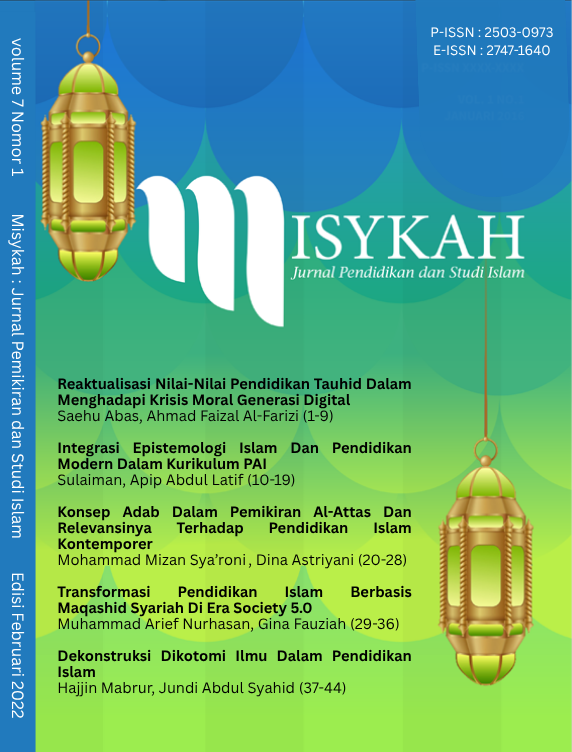
REAKTUALISASI NILAI-NILAI PENDIDIKAN TAUHID DALAM MENGHADAPI KRISIS MORAL GENERASI DIGITAL
Abstract
The rapid advancement of digital technology has profoundly reshaped the moral landscape of contemporary Muslim youth, giving rise to unprecedented ethical challenges that traditional religious education has struggled to adequately address. This study aims to examine the foundational values of tawhid education and to explore their potential for reactualization as a framework for moral restoration among the digital generation. Employing a qualitative library research methodology, this investigation systematically analyzes primary and secondary sources, including classical Islamic texts, contemporary scholarly works, and peer-reviewed academic articles relevant to Islamic education and digital ethics. The findings reveal that tawhid education, when critically recontextualized, contains intrinsic moral dimensions encompassing values of divine accountability (muraqabah), intellectual integrity (amanah), and social responsibility (mas'uliyyah) that are directly applicable to the ethical dilemmas arising from digital environments such as cyberbullying, hoaxes, and moral desensitization. The study concludes that a systematic pedagogical renewal grounded in tawhid principles constitutes a viable and theologically coherent strategy for cultivating digital moral resilience in Muslim youth.
Downloads
References
Aziz, A., & Wahyudi, M. (2022). Internalisasi nilai-nilai tauhid dalam pembentukan karakter digital remaja Muslim Indonesia. Jurnal Pendidikan Islam, 11(2), 145–162. https://doi.org/10.14421/jpi.2022.112.145
Fauzan, A., & Anwar, K. (2022). Pendidikan aqidah berbasis problem-based learning di era disrupsi teknologi. Ta'dibuna: Jurnal Pendidikan Islam, 11(1), 78–96. https://doi.org/10.32832/tadibuna.v11i1.6231
Hasanah, U., & Mujahidin, E. (2022). Pendidikan karakter berbasis tauhid di era digital. Jakarta: Rajawali Pers.
Islamic Education Research Group. (2022). Digital ethics and Islamic education: Global challenges and responses. Kuala Lumpur: IIIT.
Lutfi, M., & Sulaiman, A. (2022). Kesenjangan antara pendidikan tauhid formal dan perilaku digital pelajar Muslim. Al-Tadzkiyyah: Jurnal Pendidikan Islam, 13(2), 203–220. https://doi.org/10.24042/atjpi.v13i2.13041
Munir, M. (2021). Reaktualisasi nilai-nilai Islam dalam konteks kehidupan modern. Yogyakarta: Pustaka Pelajar.
Nur Hidayat, M. (2021). Penguatan pendidikan agama Islam berbasis karakter di era revolusi industri 4.0. Jurnal Pendidikan Agama Islam, 18(1), 55–74. https://doi.org/10.14421/jpai.2021.181.55
Ramadhan, F. (2021). Krisis moral generasi Z: Tantangan pendidikan Islam di era digital. Bandung: Mizan Pustaka.
Sugiyono. (2021). Metode penelitian kualitatif: Untuk penelitian yang bersifat eksploratif, entrepretif, interaktif dan konstruktif (edisi ke-4). Bandung: Alfabeta.
Suharto, T., & Rahayu, N. (2023). Kompetensi guru pendidikan agama Islam dalam menghadapi tantangan etika digital. Jurnal Kependidikan Islam, 13(1), 112–130. https://doi.org/10.14421/jki.2023.131.112
Syamsuddin, A. (2020). Tauhid sebagai basis epistemologi pendidikan Islam. Yogyakarta: Deepublish.
Walidah, I. A. (2017). Tabayyun di era generasi milenial. Jurnal Living Hadis, 2(1), 317–344.
https://doi.org/10.14421/livinghadis.2017.1339
Zed, M. (2014). Metode penelitian kepustakaan (3rd ed.). Yayasan Pustaka Obor Indonesia
Zed, M. (2022). Metode penelitian kepustakaan (edisi ke-3). Jakarta: Yayasan Pustaka Obor Indonesia.