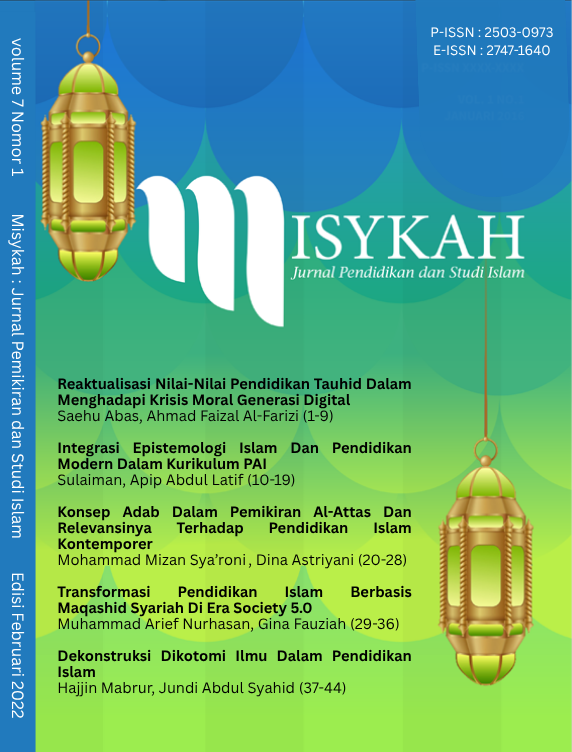
DEKONSTRUKSI DIKOTOMI ILMU DALAM PENDIDIKAN ISLAM
Keywords:
Knowledge Dichotomy, Islamic Education, Epistemological Integration, Classical Islamic Thought, Curriculum ReformAbstract
The dichotomy of knowledge in Islamic education has long been a contested intellectual terrain, separating religious sciences from secular disciplines in ways that are widely regarded as epistemologically untenable and pedagogically harmful. This study examines the historical roots and contemporary manifestations of this bifurcation, tracing its emergence from colonial educational policies and its reinforcement through institutional practices in Muslim-majority societies. The primary objective of this research is to deconstruct the epistemic foundations underpinning the sacred-secular knowledge divide and to explore integrative frameworks proposed by both classical Islamic scholars and modern educational theorists. Employing a systematic library research methodology, this study analyzes primary and secondary sources drawn from classical Islamic intellectual heritage as well as contemporary scholarly discourse. Findings reveal that classical Islamic epistemology, as articulated by figures such as al-Ghazali and Ibn Khaldun, does not substantively endorse a rigid bifurcation of knowledge domains; rather, modern dichotomization is a product of historical contingencies rather than authentic Islamic intellectual tradition. This study contributes a nuanced analytical framework for reconceptualizing Islamic educational curricula toward epistemological unity.
Downloads
References
Al-Attas, S. M. N. (2021). Islam and the philosophy of science. ISTAC-IIUM Press.
Azra, A. (2019). Pendidikan Islam: Tradisi dan modernisasi di tengah tantangan milenium III (Edisi Ketiga). Kencana Prenada Media Group.
Bakar, O. (2021). Classification of knowledge in Islam: A study in Islamic philosophies of science (2nd ed.). The Islamic Texts Society.
Creswell, J. W., & Creswell, J. D. (2021). Research design: Qualitative, quantitative, and mixed methods approaches (5th ed.). SAGE Publications.
Hashim, R. (2019). Educational dualism in Malaysia: Implications for theory and practice. The Muslim World, 109(4), 578–601. https://doi.org/10.1111/muwo.12303
Husni Rahim, M. (2020). Arah baru pendidikan Islam di Indonesia. Logos Wacana Ilmu.
Nata, A. (2021). Pemikiran pendidikan Islam dan Barat. RajaGrafindo Persada.
Nizar, S., & Syaifuddin, M. (2020). Isu-isu kontemporer tentang pendidikan Islam. Jurnal Pendidikan Islam, 9(1), 1–20. https://doi.org/10.14421/jpi.2020.91.1-20
Rijali, A. (2019). Analisis data kualitatif. Alhadharah: Jurnal Ilmu Dakwah, 17(33), 81–95. https://doi.org/10.18592/alhadharah.v17i33.2374
Sugiyono. (2021). Metode penelitian kualitatif: Untuk penelitian yang bersifat eksploratif, enterpretif, interaktif dan konstruktif (Edisi Ketiga). Alfabeta.
Wan Daud, W. M. N. (2020). The concept of knowledge in Islam and its implications for education in a developing country. Mansell Publishing.
Zainuddin, M. (2020). Integrasi keilmuan dalam pendidikan Islam: Sebuah kajian epistemologis. Jurnal Pendidikan Islam, 10(2), 215–234. https://doi.org/10.14421/jpi.2021.102.215-234.