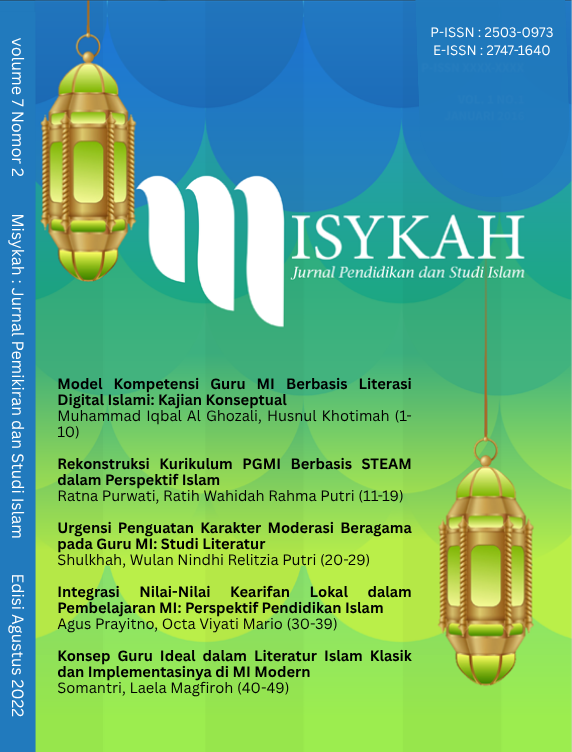
REKONSTRUKSI KURIKULUM PGMI BERBASIS STEAM DALAM PERSPEKTIF ISLAM
Keywords:
PGMI Curriculum, STEAM Education, Islamic Perspective, Curriculum Reconstruction, Islamic Higher EducationAbstract
The Program Studi Pendidikan Guru Madrasah Ibtidaiyah (PGMI) faces a critical juncture in which the demands of twenty-first-century competency-based education and the imperatives of authentic Islamic value formation must be reconciled within a coherent curricular framework. This study aims to critically examine the theoretical foundations and strategic possibilities for reconstructing the PGMI curriculum through the integration of the STEAM (Science, Technology, Engineering, Arts, and Mathematics) approach within an Islamic epistemological perspective. Employing a qualitative library research methodology, this investigation systematically reviews and synthesizes peer-reviewed journals, academic books, and policy documents published within the last five years. The findings reveal that STEAM integration within the PGMI curriculum is not only epistemologically legitimate from an Islamic standpoint but is theologically enriched when anchored in the concept of tawhid as a unifying principle of knowledge and in the Islamic understanding of human vicegerency (khilafah) as the moral rationale for scientific inquiry. The study proposes a reconstructive framework comprising ontological, axiological, and methodological dimensions that can guide future curricular renewal in PGMI programs across Indonesian Islamic higher education institutions.
Downloads
References
Hasbiyansyah, O., & Jamaludin, A. N. (2022). Analisis kurikulum PGMI di PTKIN dalam perspektif pengembangan kompetensi abad ke-21. Jurnal Tarbiyatuna: Kajian Pendidikan Islam, 6(1), 45–62. https://doi.org/10.29062/tarbiyatuna.v6i1.924
Ikhwan, A. (2021). Diskursus integrasi ilmu di Universitas Islam Negeri: Peluang dan tantangan bagi kurikulum pendidikan Islam. Jurnal Pendidikan Islam, 10(2), 167–188. https://doi.org/10.14421/jpi.2021.102.167
Mulyasa, E. (2021). Menjadi guru profesional: Menciptakan pembelajaran kreatif dan menyenangkan (edisi revisi). Bandung: Remaja Rosdakarya.
Siyoto, S., & Sodik, M. A. (2022). Dasar metodologi penelitian (edisi ke-2). Yogyakarta: Literasi Media Publishing.
Sugiyono. (2021). Metode penelitian kualitatif: Untuk penelitian yang bersifat eksploratif, entrepretif, interaktif dan konstruktif (edisi ke-4). Bandung: Alfabeta.
Suyitno, I. (2022). Pendidikan Islam integratif: Landasan teologis, epistemologis, dan pedagogis. Malang: UIN Maliki Press.
Wahyudi, I., & Rohmah, N. (2022). Pengembangan kurikulum berbasis STEAM pada program studi kependidikan Islam di era industri 4.0. Al-Tadzkiyyah: Jurnal Pendidikan Islam, 13(1), 77–94. https://doi.org/10.24042/atjpi.v13i1.11203
Winarni, E. W., Zubaidah, S., & Koes H., S. (2021). STEAM: Science, Technology, Engineering, Art, and Mathematics: Penelitian dan pembelajaran. Malang: UB Press.
Zed, M. (2022). Metode penelitian kepustakaan (edisi ke-3). Jakarta: Yayasan Pustaka Obor Indonesia.
Zubaidah, S. (2021). Mengenal STEM dan STEAM dalam pembelajaran abad ke-21: Relevansinya bagi pendidikan Islam. Jurnal Pendidikan Sains Indonesia, 9(2), 221–234. https://doi.org/10.24815/jpsi.v9i2.20294
Tobroni, & Syamsul, A. (2022). Pendidikan Islam: Paradigma teologis, filosofis, dan spiritualitas. Malang: UMM Press.
Langgulung, H. (2021). Pendidikan Islam menghadapi abad ke-21: Relevansi kurikulum dan metodologi. Jakarta: Pustaka Al-Husna.