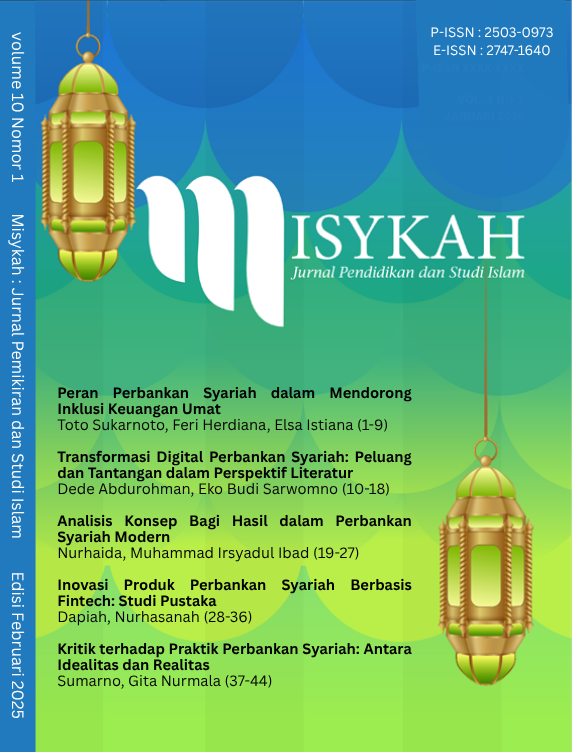
PERAN PERBANKAN SYARIAH DALAM MENDORONG INKLUSI KEUANGAN UMAT
Keywords:
Islamic Banking, Financial Inclusion, Sharia-Compliant Finance, Muslim Community, MicrofinanceAbstract
Financial exclusion remains one of the most persistent structural challenges in majority-Muslim developing countries, where a substantial portion of the population refrains from engaging with conventional banking institutions due to concerns about riba (interest). Islamic banking, with its foundational commitment to Sharia-compliant financial principles, theoretically presents a viable and culturally consonant mechanism for extending financial services to underserved communities. This study aims to examine the role of Islamic banking in advancing financial inclusion among the Muslim community, with particular emphasis on identifying the mechanisms, achievements, and structural barriers involved. Employing a qualitative library research methodology, this investigation systematically reviews and synthesizes peer-reviewed articles, institutional reports, and academic books published within the last five years. The findings reveal that Islamic banking contributes to financial inclusion through microfinancing instruments, zakat and waqf integration, digital banking transformation, and community-based financial intermediation. However, significant barriers including limited public literacy, inadequate infrastructure, and weak regulatory frameworks continue to constrain its optimal impact. This study concludes that a holistic, collaborative approach among government, regulators, and Islamic financial institutions is essential for maximizing the financial inclusion potential of Islamic banking.
Downloads
References
Anshori, A. G. (2021). Perbankan syariah di Indonesia: Aspek hukum dan perkembangannya (edisi ke-3). Yogyakarta: Gadjah Mada University Press.
Creswell, J. W., & Creswell, J. D. (2022). Research design: Qualitative, quantitative, and mixed methods approaches (6th ed.). SAGE Publications.
Fitriyani, N., & Suroso, A. (2022). Keuangan mikro syariah dan inklusi keuangan masyarakat pedesaan: Studi pada BMT di Jawa Tengah. Jurnal Ekonomi dan Keuangan Islam, 8(1), 45–63. https://doi.org/10.20885/jeki.vol8.iss1.art4
Hasan, Z., & Ascarya, A. (2022). Ekonomi dan keuangan syariah: Teori dan praktik kontemporer. Jakarta: Rajawali Pers.
Ismail, A., & Pratama, B. (2023). Transformasi digital perbankan syariah dan akselerasi inklusi keuangan pasca-pandemi di Indonesia. Al-Iqtishad: Jurnal Ilmu Ekonomi Syariah, 15(1), 87–108. https://doi.org/10.15408/aiq.v15i1.28901
Kasri, R. A., & Anggiani, M. (2022). Perbankan syariah, inklusi keuangan, dan pengentasan kemiskinan: Bukti empiris dari Indonesia. Jurnal Keuangan dan Perbankan, 26(3), 512–530. https://doi.org/10.26905/jkdp.v26i3.7812
Rokhman, W., & Syaifudin, A. (2021). Hambatan religius dan inklusi keuangan: Studi pada masyarakat Muslim pedesaan di Indonesia. Jurnal Bisnis dan Manajemen Islam, 9(2), 167–184. https://doi.org/10.21043/bisnis.v9i2.11234
Rusydiana, A. S., & Devi, A. (2022). Wakaf produktif dan keuangan sosial Islam: Model pemberdayaan ekonomi berbasis komunitas. Bogor: SMART Publishing.
Sugiyono. (2021). Metode penelitian kualitatif: Untuk penelitian yang bersifat eksploratif, entrepretif, interaktif dan konstruktif (edisi ke-4). Bandung: Alfabeta.
World Bank. (2022). The Global Findex Database 2021: Financial inclusion, digital payments, and resilience in the age of COVID-19. Washington, D.C.: The World Bank Group.
Zed, M. (2022). Metode penelitian kepustakaan (edisi ke-3). Jakarta: Yayasan Pustaka Obor Indonesia.