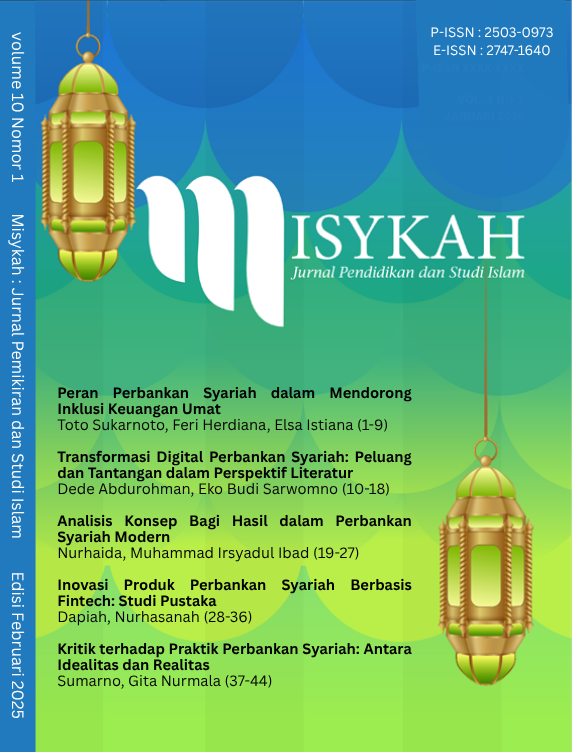
TRANSFORMASI DIGITAL PERBANKAN SYARIAH: PELUANG DAN TANTANGAN DALAM PERSPEKTIF LITERATUR
Keywords:
Digital Transformation, Islamic Banking, Financial Technology, Sharia Compliance, Financial InclusionAbstract
The rapid acceleration of digital technology in the financial sector has fundamentally altered the operational architecture of banking institutions globally, including those operating under Islamic financial principles. This study aims to systematically examine the opportunities and challenges encountered by Islamic banking institutions in implementing digital transformation, viewed through the lens of existing scholarly literature. Employing a library research methodology, this investigation synthesizes peer-reviewed journal articles and academic books published between 2020 and 2024. Primary data were gathered through systematic documentation of scholarly sources, then subjected to content analysis and source triangulation to ensure interpretive validity. Findings reveal that digital transformation generates substantial opportunities for Islamic banks, encompassing financial inclusion expansion, operational efficiency enhancement, and new product innovation aligned with sharia principles. Conversely, significant challenges persist, including regulatory adaptation gaps, cybersecurity vulnerabilities, customer trust cultivation difficulties, and sharia compliance maintenance complexities within automated digital ecosystems. This study contributes a comprehensive analytical framework to inform policymakers and Islamic banking practitioners navigating the digital transition effectively and sustainably.
Downloads
References
Abdullah, N., & Majid, M. S. A. (2021). Digital financial inclusion and Islamic finance: Evidence from Muslim-majority countries. Journal of Islamic Finance, 10(2), 45–61. https://doi.org/10.31436/jif.v10i2.481
Creswell, J. W., & Creswell, J. D. (2022). Research design: Qualitative, quantitative, and mixed methods approaches (6th ed.). SAGE Publications.
Fauzi, A., & Hermawan, D. (2023). Regulatory challenges of Islamic fintech in Indonesia: A critical analysis. Jurnal Ekonomi dan Perbankan Syariah, 11(2), 112–130. https://doi.org/10.15548/jebi.v11i2.6572
Hamdan, A., AlKadhi, A., & Sarea, A. (2021). Blockchain technology in Islamic banking: An exploratory study. Journal of Islamic Marketing, 12(6), 1229–1247. https://doi.org/10.1108/JIMA-08-2019-0168
Hidayat, S. E., Al-Shammari, M., & Abdulraheem, I. (2023). Artificial intelligence and sharia compliance in Islamic banking: Emerging issues and prospects. International Journal of Islamic and Middle Eastern Finance and Management, 16(2), 335–352. https://doi.org/10.1108/IMEFM-03-2022-0100
Kasim, N., & Mohamed, N. A. (2022). Financial inclusion through Islamic digital banking: A systematic review. Global Journal of Al-Thaqafah, 12(1), 25–44. https://doi.org/10.7187/GJAT01122022-1
Mukhtar, M. U., & Rahman, M. (2022). Islamic fintech and financial inclusion: Opportunities and challenges for Muslim-majority economies. Journal of King Abdulaziz University: Islamic Economics, 35(1), 3–21. https://doi.org/10.4197/Islec.35-1.1
Pratiwi, R. D., & Sari, I. N. (2023). Perkembangan dan tantangan perbankan syariah digital di Indonesia pasca pembentukan Bank Syariah Indonesia. Jurnal Ekonomi dan Perbankan Syariah, 11(1), 78–95. https://doi.org/10.15548/jebi.v11i1.6231
Rosly, S. A., & Mohd Yusof, R. (2022). Islamic banking and financial markets: An introduction (3rd ed.). IIUM Press.
Sugiyono. (2021). Metode penelitian kualitatif (4th ed.). Alfabeta.
Vial, G. (2021). Understanding digital transformation: A review and a research agenda. Journal of Strategic Information Systems, 28(2), 118–144. https://doi.org/10.1016/j.jsis.2019.01.003
Zed, M. (2022). Metode penelitian kepustakaan (5th ed.). Yayasan Pustaka Obor Indonesia.