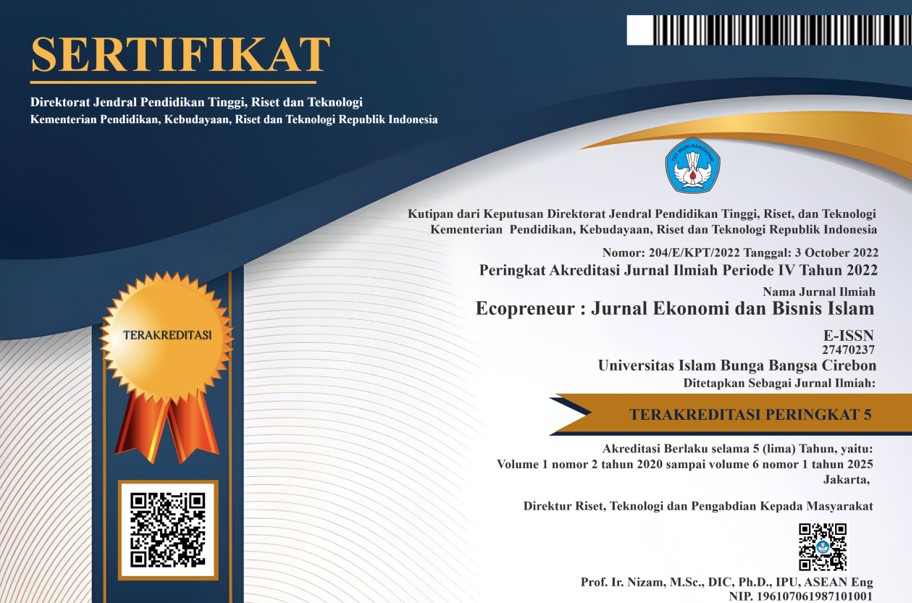
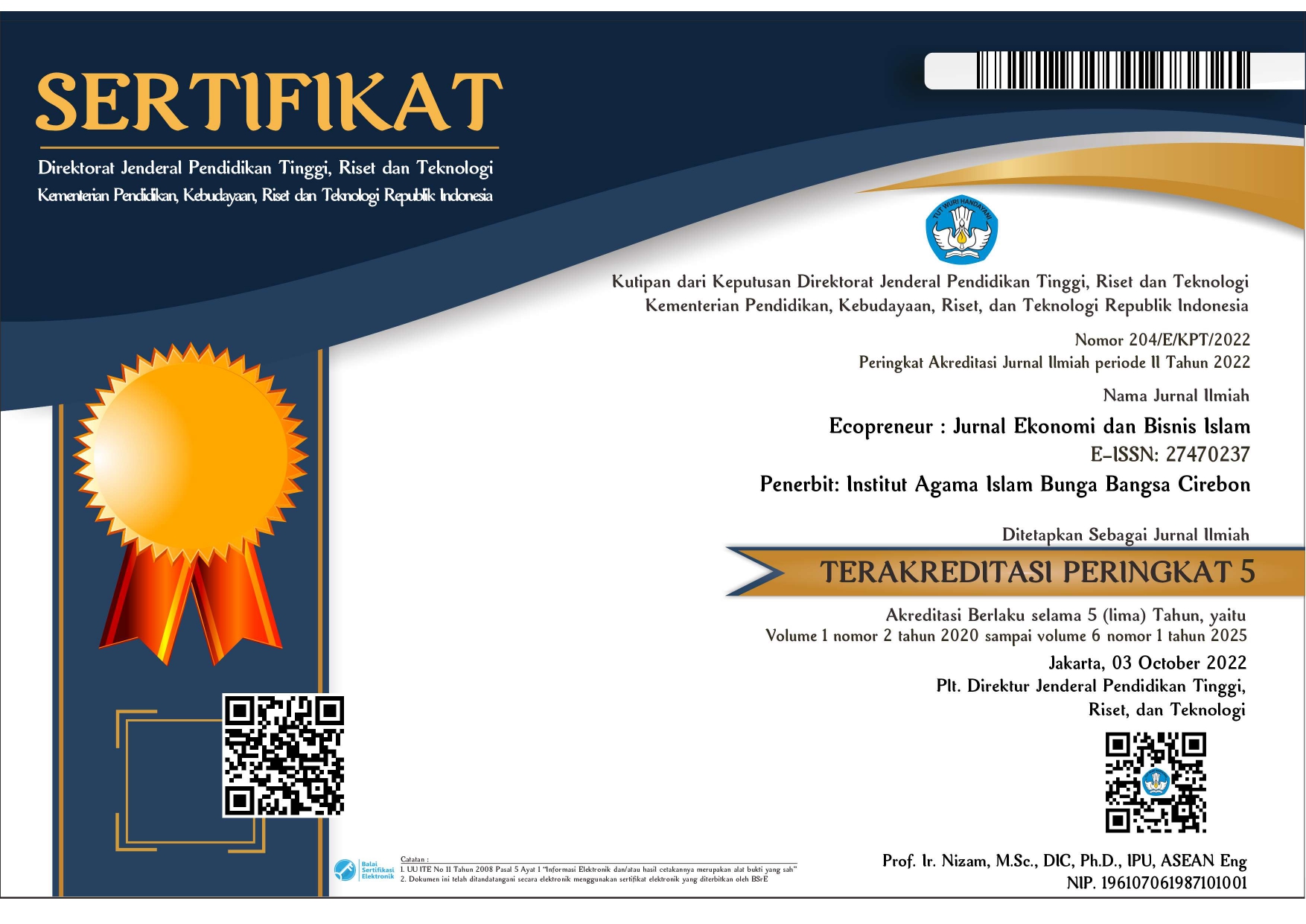
Strengthening the Islamic Boarding School-Based Economy and Entrepreneurship Towards Economic Independence (Case Study at the Al-Bahjah Sumber Islamic Boarding School, Cirebon Regency)
DOI:
https://doi.org/10.47453/ecopreneur.v6i1.3085Keywords:
Islamic boarding school-based entrepreneurship, economic independence, Islamic Boarding SchoolAbstract
Many Islamic boarding schools do not yet have economic independence, so the concept of Islamic boarding school independence must continue to be promoted not only for the internal interests of the Islamic boarding school, but also for the social interests of society, so that the existence of Islamic boarding schools can be felt by the community. This research aims to examine the strengthening of Islamic boarding school-based entrepreneurship towards economic independence in Pondok Al-Bahjah, Cirebon Regency. The research method used is a qualitative approach with a case study design. Data was collected through in-depth interviews, participant observation and documentation. The research results show three main findings, including: First, efforts to strengthen Islamic boarding school-based entrepreneurship are carried out through Economics and Entrepreneurship, creating products that are able to compete in the market, as well as improving skills in entrepreneurship. Second, factors that influence the success of entrepreneurship programs include good leadership and management, adequate human resources, entrepreneurship education, technology and innovation, supporting infrastructure and facilities, partnerships, monitoring and evaluation which are carried out regularly. Third, the impact of strengthening Islamic boarding school-based entrepreneurship is increasing the economic independence of students, developing students' skills, and improving the welfare of students and residents in the area around Islamic boarding schools. The implications of this study show that strengthening entrepreneurship in Al-Bahjah Islamic Boarding School, Cirebon Regency has an impact on three important areas: increasing the economic independence of the pesantren and the surrounding community through various business units, improving the welfare of students and the community by creating jobs, and developing entrepreneurial skills of students as a provision for their future. This changes the role of pesantren from just an Islamic educational institution to a social institution with strategic economic contribution.
Downloads
References
Akbar, Muh. 2019. “Kajian Terhadap Revisi Undang-Undang No. 13 Tahun 1998 Tentang Kesejahteraan Sosial Lanjut Usia.” Jurnal Mimbar Kesejahteraan Sosial 2(2). https://journal3.uin-alauddin.ac.id/index.php/jmks/article/view/10605 (February 27, 2025).
Awwaliyah, Neny Muthi’atul. 2019. “Pondok Pesantren Sebagai Wadah Moderasi Islam Di Era Generasi Millenial.” Islamic Review: Jurnal Riset dan Kajian Keislaman 8(1): 36–62.
Badruzzaman, Deden Fajar. 2009. “Pemberdayaan Kewirausahaan Terhadap Santri Di Pondok Pesantren: Studi Kasus Pondok Pesantren Al-Ashriyyah Nurul Iman Parung, Bogor.” https://repository.uinjkt.ac.id/dspace/bitstream/123456789/18159/1/DEDEN%20FAJAR%20BADRUZZAMAN-FSH.pdf (February 27, 2025).
Ghofir, Jamal, and Hibrul Umam. 2020. “Transformasi Nilai Pendidikan Keberagamaan Pada Generasi Milenial.” Tadris: Jurnal Penelitian Dan Pemikiran Pendidikan Islam 14(1): 92–111.
Gustriani, Tini, and Mohd Kholis. 2024. “Pembelajaran Life Skills Bagi Santri Sebagai Inovasi Pendidikan Di Pesantren.” Ainara Journal (Jurnal Penelitian Dan PKM Bidang Ilmu Pendidikan) 5(3): 290–96.
Harahap, Solehuddin, and Dafiar Syarif. 2022. “Model Dan Strategi Pengembangan Bisnis Pondok Pesantren Modern Subulussalam Padang Pariaman.” Jihbiz: Jurnal Ekonomi, Keuangan Dan Perbankan Syariah 6(1): 27–47.
Hardiyati, Mikyal, Anni Waridatul Hasanah, and Nur Rohman. 2023. “Analisis Kesejahteraan Sosial Sebagai Disiplin Ilmu.” Icodev: Indonesian Community Development Journal 4(2): 89–94.
Hikmah, Nuril, Muhammad Arif Kurniawan, and Dwi Harmoyo. 2024. “Penguatan Kewirausahaan Berbasis Pesantren Menuju Kemandirian Ekonomi:(Studi Kasus Di Pondok Pesantren Mannallah Bantul Yogyakarta).” Al-Iqtishod: Jurnal Ekonomi Syariah 6(1): 139–58.
Husen, Kemal, and Muhammad Husni. 2025. “Peran Pesantren Dalam Meneguhkan Identitas Budaya Indonesia Di Tengah Arus Modernisasi.” IHSAN: Jurnal Pendidikan Islam 3(1): 387–97.
Jannah, Hasanatul. 2014. “Pesantren Dan Pusat Konseling Bagi Generasi Muda.” Konseling Religi: Jurnal Bimbingan Konseling Islam 5(1): 95–114.
Kurniawan, Muhammad Arif. 2022. “Pesantrenpreneur Dan Sosiopreneur Sebagai Alternatif Gerakan Moderasi Ekonomi Pasca Pandemi Di Pesantren Yogyakarta.” MALIA: Jurnal Ekonomi Islam 14(1): 85–105.
Puspitasari, Dewi Cahyani. 2019. “Menjadi Sociopreneur Muda: Studi Kasus Momsociopreneur ‘Sanggar ASI’.” Jurnal Studi Pemuda 7(2): 76–89.
Rahmah, Rizki Fathia. 2018. “Peranan Koperasi Dalam Meningkatkan Kesejahteraan Masyarakat Di Sekitar Pondok Pesantren Roudlatul Qur’an Kota Metro.” PhD Thesis. IAIN Metro. http://repository.metrouniv.ac.id/id/eprint/712/ (February 27, 2025).
Sari, Indah Fitriana, and Muhammad Rafiâ. 2023. “Dampak Evolusi Perlindungan Sosial Terhadap Kesejahteraan Sosial Dalam Perspektif Ekonomi Islam.” Jurnal Ilmiah Ekonomi Islam 9(1): 1080–87.
Sofia, Irma Paramita. 2017. “Konstruksi Model Kewirausahaan Sosial (Social Entrepreneurship) Sebagai Gagasan Inovasi Sosial Bagi Pembangunan Perekonomian.” Widyakala Journal: Journal of Pembangunan Jaya University 2(1): 2–23.
Sriani, Endang. 2022. “Peran Santripreneur Pondok Pesantren Edi Mancoro Terhadap Kemandirian Pesantren Dan Masyarakat.” Jurnal Ilmiah Ekonomi Islam 8(3): 3383–93.
Sudarko, Sudarko, and Prabowo Tjitropranoto. 2018. “Telaah Perubahan Paradigma Kewirausahaan Dari Perspektif Inovasi Ekonomi Dan Sosial.” Jurnal Ilmiah Respati 9(2). https://ejournal.urindo.ac.id/index.php/pertanian/article/view/298 (February 27, 2025).
Usman, Idris Muhammad. 2013. “Pesantren Sebagai Lembaga Pendidikan Islam.” Jurnal Al Hikmah 14(1): 101–19.
Wahidah, Evita Yuliatul. 2016. “Studi Implementasi Tradisionalisasi Dan Modernisasi Pendidikan Di Pondok Pesantren.” Muaddib: Studi Kependidikan dan Keislaman 5(2): 184–207.
Wiranata, Rz Ricky Satria. 2019. “Tantangan, Prospek Dan Peran Pesantren Dalam Pendidikan Karakter Di Era Revolusi Industri 4.0.” AL-MANAR: Jurnal Komunikasi Dan Pendidikan Islam 8(1): 61–92.
Additional Files
Published
Issue
Section
License
Copyright (c) 2025 Authors

This work is licensed under a Creative Commons Attribution 4.0 International License.