The Role of QRIS in the Perspective of Islamic Economics: A Case Study of Photocopying Around the Banyumas Campus
DOI:
https://doi.org/10.47453/ecopreneur.v6i1.3089Keywords:
QRIS, Sharia Economy, Photocopying, Digital Payment System, Financial InclusionAbstract
The development of digital technology has driven transformation in various aspects of life, including payment systems. One of the innovations developed in Indonesia is the Quick Response Code Indonesian Standard (QRIS), which has been widely adopted in various sectors, including small and medium enterprises. This study aims to analyze the role of QRIS from the perspective of Islamic economics with a case study of a photocopying business around the Banyumas campus. The method used is qualitative with a case study approach, where data is collected through observation, interviews with photocopying business owners and students as the main users, and literature studies related to Islamic economics. The results of the study indicate that the implementation of QRIS in photocopying provides various benefits, such as ease of transactions, operational efficiency, and increased convenience for students. However, there are several challenges in implementing QRIS, especially related to transaction fee deductions that potentially contain usury elements and delays in disbursing funds to recipient accounts. From a Sharia economic perspective, although the use of QRIS, in general, does not conflict with Sharia principles, aspects of contracts, transparency, and fairness in transaction costs need to be studied further to comply with the principles of Islamic muamalah. This study recommends education for business actors and students regarding Sharia financial literacy in digital systems and the development of QRIS mechanisms that are more on Islamic economic principles. In addition, further research related to QRIS regulations and policies in the Sharia economic system is needed to ensure that this digital payment system can fully support Sharia-based financial inclusion.
Downloads
References
The development of digital technology has driven transformation in various aspects of life, including payment systems. One of the innovations developed in Indonesia is the Quick Response Code Indonesian Standard (QRIS), which has been widely adopted in various sectors, including small and medium enterprises. This study aims to analyze the role of QRIS from the perspective of Islamic economics with a case study of a photocopying business around the Banyumas campus. The method used is qualitative with a case study approach, where data is collected through observation, interviews with photocopying business owners and students as the main users, and literature studies related to Islamic economics. The results of the study indicate that the implementation of QRIS in photocopying provides various benefits, such as ease of transactions, operational efficiency, and increased convenience for students. However, there are several challenges in implementing QRIS, especially related to transaction fee deductions that potentially contain usury elements and delays in disbursing funds to recipient accounts. From a Sharia economic perspective, although the use of QRIS, in general, does not conflict with Sharia principles, aspects of contracts, transparency, and fairness in transaction costs need to be studied further to comply with the principles of Islamic muamalah. This study recommends education for business actors and students regarding Sharia financial literacy in digital systems and the development of QRIS mechanisms that are more on Islamic economic principles. In addition, further research related to QRIS regulations and policies in the Sharia economic system is needed to ensure that this digital payment system can fully support Sharia-based financial inclusion.
Keywords: QRIS, Sharia Economy, Photocopying, Digital Payment System, Financial Inclusion.
Copyright © 2025, Authors.
INTRODUCTION
The development of digital technology has brought significant changes in various aspects of life, including payment systems (Adisel & Prananosa, 2020). One of the innovations that is developing rapidly in Indonesia is the Quick Response Code Indonesian Standard (QRIS), which was introduced by Bank Indonesia as a national standard for QR code-based payments. (Oktaviani, 2024). QRIS enables faster, easier and more efficient transactions, so it is widely used in various business sectors, including small and medium enterprises (Kristanty 2024). The use of QRIS is increasingly widespread, especially in campus environments that have high mobility, such as photocopying around the Banyumas campus (Abinnashih and Nurfuadi 2023).
Photocopying businesses around campus have an important role in supporting students' academic needs, both in printing assignments, duplicating lecture materials, and other administrative needs (Atira, Haeruddin, and Kurniawan 2024). As digital transactions increase, many photocopying businesses are starting to switch to the QRIS payment system to provide convenience for their customers. The use of QRIS in these transactions provides flexibility and convenience (Carera, Gunawan, and Fauzi 2022).
However, even though QRIS offers various conveniences, its application in the context of sharia economics is still a topic that needs further review. In the perspective of Islamic economics, the financial system must be based on the principles of justice, transparency, and mutual benefit (Muttaqin 2024). This includes aspects of clarity in transaction contracts, free from elements of usury, gharar (uncertainty), and maysir (speculation). (Pratama et al. 2021). Therefore, it is important to examine whether this payment system meets these criteria, considering that financial digitalization can present new challenges related to compliance with sharia principles. In addition, there are other obstacles in implementing QRIS, such as the existence of transaction fee deductions that are considered as interest in the sharia economy (Muttaqin 2024). Some business actors also experience difficulties related to delays in funds entering their accounts after transactions are made, which can hinder the smooth operation of their business (Kristia and Ahmadi 2024).
Several previous studies have examined the use of QRIS from a sharia economic perspective. The study conducted by Burhanuddin highlighted that QRIS as a digital payment system can support more efficient transactions, but it is still necessary to pay attention to the sharia aspects related to the potential for gharar and usury in the transaction mechanism (Burhanuddin 2024). Meanwhile, research by Patria Yunita et al found that most QRIS users in the MSME sector do not fully understand the applicable contracts in digital transactions, so further education is needed to comply with sharia principles (Yunita et al. 2022).
Furthermore, research conducted by Insan Saputra shows that the use of QRIS in sharia financial transactions has a positive impact in accelerating financial digitalization, but there are still challenges in terms of sharia financial literacy among the community (Saputra and Febrian 2025). Meanwhile, a study by Indra Prawana confirms that the QRIS system has great potential in supporting Sharia-based financial inclusion, but there are still technical and regulatory obstacles that need to be adjusted to be more in line with Islamic economic principles (Prawana 2024).
Based on this background, this study aims to analyze the use of QRIS in transactions at photocopying businesses around the Banyumas campus and examine its suitability with sharia economic principles. In addition, this study will also identify the benefits and challenges faced by business actors and students as the main users in implementing a QRIS-based digital payment system.
RESEARCH METHODOLOGY
This study uses a qualitative approach with a case study method that focuses on the use of QRIS in transactions at photocopying businesses around the Banyumas campus. Data collection techniques are carried out through observation, interviews, and literature studies (Sugiyono 2020). Observations were conducted by directly observing the transaction process using QRIS in several photocopy shops to understand how this system is implemented and accepted by business actors and consumers. Interviews were conducted with photocopy shop owners, namely Nurul Burhan from Prima Fotokopi and Taufiq from Berkah Fotokopi, to explore the reasons for using QRIS, the benefits felt, and the obstacles faced in its implementation. In addition, interviews were also conducted with students as the main consumers, namely Diva from UIN Saifuddin Zuhri and Nanda from Jenderal Sudirman University, to find out their experiences in using QRIS, ease of transactions, and their perceptions regarding the suitability of this payment system with sharia economic principles. Literature studies were conducted by reviewing various references from journals, books, and articles that discuss QRIS and the principles of Islamic economics to strengthen the analysis in this study. The data obtained were analyzed descriptively qualitatively with the aim of describing the pattern of QRIS use in photocopy transactions, identifying the benefits and challenges that arise, and assessing its suitability with sharia economic principles (Sugiyono 2020). Through this approach, this research is expected to provide a comprehensive understanding of the impact of payment digitalization on small businesses and how QRIS can be optimally integrated into a sharia-based economic system
RESULTS AND DISCUSSION
Implementation of QRIS in Photocopying Offices Around Banyumas Campus
Based on the results of interviews with the owners of Prima Fotokopi (Prima FC) and Berkah Fotokopi (Berkah FC), as well as several students who are the main customers, it was found that the use of QRIS in photocopying transactions around the Banyumas campus has experienced a fairly high level of adoption. The owner of Prima FC stated that since the beginning of the establishment of his photocopying business, the QRIS payment system has been implemented as part of a strategy to facilitate transactions (Manurung et al. 2024). One of the main reasons for using QRIS is to overcome the problem of change, which is a frequent complaint from students (Santi and Chalid 2024). In conventional transactions, students often experience difficulties when paying with cash because business owners do not have small change to give change (Budiwitjacksono and Septa 2023). With QRIS, students can pay the correct amount without having to worry about the availability of change, making transactions more practical and efficient.
On the other hand, the owner of Berkah FC also mentioned that the use of QRIS makes it easier to record transactions. This digital system allows every transaction to be recorded automatically in their business financial system, reducing the risk of manual recording errors, and providing better transparency in financial reports. With a digital transaction track record, business owners can easily monitor cash flow and manage their income more systematically. This is one of the factors that encourages small business owners to switch to a digital payment system.
In addition to the benefits for business actors, students as the main consumers also feel the benefits of using QRIS. Based on interviews with several students, such as Diva from UIN Saifuddin Zuhri and Nanda from Jenderal Sudirman University, they revealed that the use of QRIS is very helpful in their academic lives. Students often need photocopying services in large quantities and in a short time, especially before exams or when there are urgent assignments. With QRIS, the payment process is faster compared to cash payments, because there is no need to wait for change or count money manually. In addition, students also feel safer in making transactions because they do not need to carry large amounts of cash, which can be at risk of being lost or scattered.
However, even though QRIS provides convenience in transactions, there are still several obstacles faced by business actors and students. One problem that often arises is the transaction fee deduction imposed by QRIS service providers. Photocopy shop owners complain that this deduction, although relatively small, still affects their profit margins, especially in small businesses with high transaction volumes but relatively small values per transaction. In addition, several students also complained that in some cases, the funds they transferred via QRIS did not immediately enter the recipient's account, causing uncertainty in the transaction. Although this is rare, this kind of incident remains a concern, especially for students who are in a hurry or have urgent needs.
From a sharia economic perspective, the use of QRIS in photocopying transactions needs to be studied further regarding its compliance with sharia principles (Endita and Wirsa 2023). In interviews with students who have an understanding of Islamic economics, there are differences of opinion regarding the suitability of QRIS with the principles of Islamic economics. Some students argue that QRIS is a modern solution that facilitates transactions and does not contain elements of usury directly, so it can be accepted in the Islamic economic system (Nuha and Ariyani 2024). However, there are also students who criticize the deduction of transaction fees charged by service providers, which can be categorized as usury if there is no clear justification for the administration fees charged (Sukrianti and Mapuna 2022). Therefore, a more in-depth study is needed on how the QRIS business model can be adjusted to Islamic economic principles, so that it continues to provide benefits to users without violating sharia rules.
QRIS in the Perspective of Islamic Economics
Based on the results of interviews with the owners of Prima FC and Berkah FC and several students, the implementation of QRIS in photocopying shops around the Banyumas campus has had a significant impact on daily transactions. From an Islamic economic perspective, the aspect of the contract in the use of QRIS is the main thing that needs to be analyzed (Lubaba, Paturrohman, and Khoriâ€TMah 2021). In Islamic law, a transaction is said to be valid if it fulfills the terms and conditions of the contract, even without a verbal consent. (Ertanti and Fahrazi 2022). This is in accordance with sharia principles which prioritize clarity and fairness in transactions.
In the context of QRIS, the sale and purchase agreement occurs when students as customers choose services at the photocopy shop, determine the amount of payment, and make transactions via QRIS. Although there is no verbal ijab qabul, the transaction is still considered valid because there is an agreement and clarity on the value paid (Munandar and Ridwan 2023). However, it is necessary to observe whether there is an element of gharar (uncertainty) or usury in this transaction mechanism.
One of the main issues in the use of QRIS is the potential for gharar and riba elements in transaction fee deductions (Yulistiani and Mukarromah 2020). Based on the interview results, the photocopy owner revealed that each QRIS transaction is subject to a certain deduction, the amount of which varies depending on the policy of the digital financial service provider. From an Islamic economic perspective, this additional fee needs to be further studied whether it is included in the category of usury or simply a legitimate administrative fee in business transactions. If the deduction is a form of profit for a third party without any clear service, then it can be categorized as usury (Annisa et al. 2024). However, if the deduction is used for the operational costs of the system, then it can be considered as a wage that is justified in Islam.
In addition, QRIS has a significant impact on financial inclusion of the people, especially for small business actors. With QRIS, photocopying businesses that previously only accepted cash transactions can now serve a wider range of customers, including students who are more accustomed to digital payments. QRIS also increases financial transparency, because every transaction is recorded automatically and can be accessed at any time by the business owner.
QRIS Impact on Business Actors and Students
For Business Actors
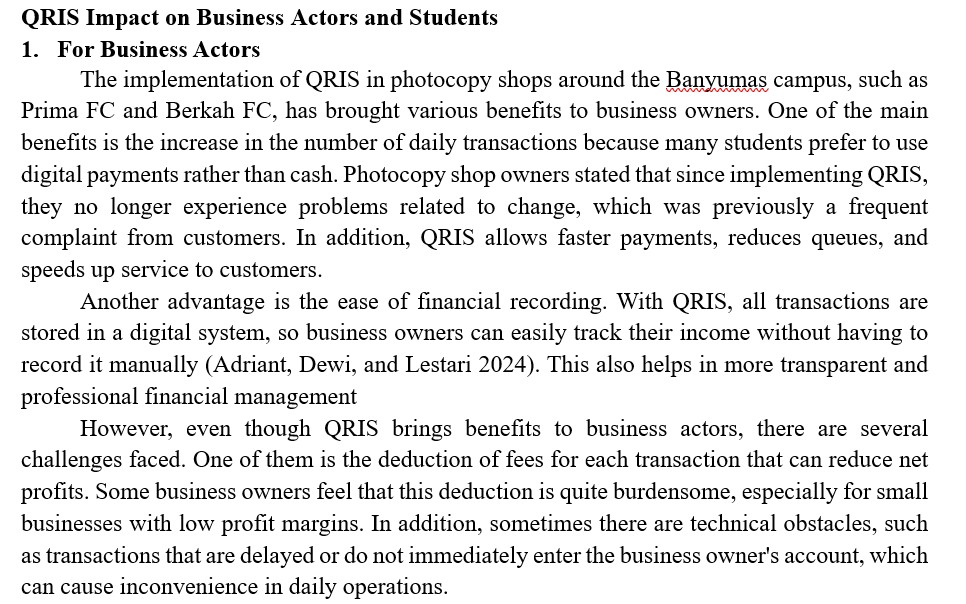
The implementation of QRIS in photocopy shops around the Banyumas campus, such as Prima FC and Berkah FC, has brought various benefits to business owners. One of the main benefits is the increase in the number of daily transactions because many students prefer to use digital payments rather than cash. Photocopy shop owners stated that since implementing QRIS, they no longer experience problems related to change, which was previously a frequent complaint from customers. In addition, QRIS allows faster payments, reduces queues, and speeds up service to customers.
Another advantage is the ease of financial recording. With QRIS, all transactions are stored in a digital system, so business owners can easily track their income without having to record it manually (Adriant, Dewi, and Lestari 2024). This also helps in more transparent and professional financial management
However, even though QRIS brings benefits to business actors, there are several challenges faced. One of them is the deduction of fees for each transaction that can reduce net profits. Some business owners feel that this deduction is quite burdensome, especially for small businesses with low profit margins. In addition, sometimes there are technical obstacles, such as transactions that are delayed or do not immediately enter the business owner's account, which can cause inconvenience in daily operations.
For Students
For students, the use of QRIS provides convenience in payments. They no longer need to carry large amounts of cash, which reduces the risk of losing or running out of change. Most of the students interviewed, such as Diva from UIN Saifuddin Zuhri and Nanda from Jenderal Soedirman University, stated that they felt safer and more comfortable using QRIS than cash. In addition, QRIS allows for faster and more practical transactions, especially when the queue at the photocopy shop is busy. However, there are several obstacles experienced by students in using QRIS. One of the main problems is the limited internet network. Several students complained that when the network was unstable, transactions via QRIS became difficult to do. In addition, some students still do not fully understand how the QRIS system works, including the potential additional fees that may be charged when using certain digital wallets. Therefore, further education is needed so that students better understand this digital payment system.
Challenges in Implementing QRIS
Although QRIS provides various benefits, there are several challenges that still need to be overcome in its implementation in photocopying businesses around the Banyumas campus. One of the main challenges is the lack of understanding of business actors regarding sharia economics in digital transactions. Some business owners do not yet understand whether transaction deductions in QRIS can be categorized as usury or simply legitimate administrative fees. Therefore, further socialization is needed regarding the principles of Islamic economics in digital transactions.
Another challenge is the limited digital infrastructure. Not all business actors have devices that optimally support QRIS transactions. In addition, technical problems such as delayed or failed transactions are also obstacles that need further attention. Dependence on electronic systems can also be a risk if there is a disruption to the server or payment network.
Overall, the use of QRIS in photocopying businesses around the Banyumas campus has brought various benefits, both for business actors and students. From a sharia economic perspective, QRIS can be categorized as a legitimate payment system if it does not contain elements of usury and gharar which are prohibited in Islam. However, there are still several challenges that need to be overcome, especially in terms of digital literacy and understanding the principles of Islamic economics in digital transactions. Therefore, further education is needed for business actors and students so that they can understand and utilize QRIS more optimally in accordance with sharia principles.
The implications of the implementation of QRIS in photocopiers around the Banyumas campus show a significant impact on transaction efficiency and business management. For business owners such as Prima FC and Berkah FC, QRIS solves the problem of change, makes it easier to record financial statements automatically, increases the transparency of financial statements, and expands customer reach, even though the discount on transaction fees reduces profit margins. Meanwhile, for students like Diva and Nanda, QRIS offers faster, more practical, and safer transactions without the need to carry large amounts of cash, even though they are constrained by unstable internet network problems. From the perspective of sharia economics, the use of QRIS raises debates about its suitability with sharia principles, especially related to the potential elements of gharar and riba in transaction fee discounts, so further studies are needed on how the QRIS business model can be adjusted to Islamic economic principles in order to continue to provide benefits without violating sharia rules, as well as further socialization and education regarding digital literacy and understanding of Islamic economic principles in digital transactions for business actors and students.
CONCLUSION
Based on the research results, it can be concluded that QRIS has been widely implemented in photocopy shops around the Banyumas campus as a digital payment system. The existence of QRIS provides convenience in transactions for students and increases operational efficiency for business actors. The use of QRIS helps reduce obstacles in payments, such as cash change problems, and creates neater and more structured transaction records. However, from a sharia economic perspective, there are still aspects that need to be studied further, especially related to transaction fee deductions that have the potential to contain elements of usury and gharar. Therefore, although QRIS can support the sharia economy, its implementation must still pay attention to the principles of contracts that are in accordance with Islam so that transactions can be carried out more transparently and fairly. To improve understanding and suitability of QRIS with the sharia economy, further education is needed for business actors and students regarding the sharia financial system in digital transactions. Socialization regarding the contracts that apply in the Islamic economy and how QRIS can be implemented without violating sharia principles is an important step in creating a more Islamic digital payment ecosystem. In addition, there is a need for the development of sharia-based QRIS with a more transparent mechanism and does not contain elements of usury or gharar, so that it is more in accordance with Islamic economic principles. This study only focuses on the implementation of QRIS in photocopying transactions around the Banyumas campus from a sharia economic perspective. Therefore, further research is needed to analyze QRIS policies and regulations in Islamic economics more broadly, including in other more diverse business sectors and in the context of Islamic banking and Islamic-based financial inclusion. With a more in-depth study, it is hoped that the digital payment system in Indonesia can be more in line with sharia principles and provide greater benefits to society.
REFERENCES
Abinnashih, Ibnu, and Nurfuadi Nurfuadi. 2023. “Kompetensi Manajerial Kepala Madrasah Dalam Meningkatkan Kinerja Pendidik Dan Tenaga Kependidikan.” Edukatif : Jurnal Ilmu Pendidikan 5(1): 543–49. doi:10.31004/edukatif.v5i1.4451.
Adisel, Adisel, and Ahmad Gawdy Prananosa. 2020. “Penggunaan Teknologi Informasi Dan Komunikasi Dalam Sistem Manajemen Pembelajaran Pada Masa Pandemi Covid 19.” Journal Of Administration and Educational Management (ALIGNMENT) 3(1): 1–10. doi:10.31539/alignment.v3i1.1291.
Adriant, Irayanti, Nurlaela Kumala Dewi, and Tia Murti Lestari. 2024. “Perancangan Sistem Point Of Sales Pada Toko Samiaji Menggunakan Vba (Visual Basic For Application) Macro Excel.” Neraca: Jurnal Ekonomi, Manajemen dan Akuntansi 2(2): 615–34. doi:10.572349/neraca.v2i2.1071.
Annisa, Nabila Nur, Leli Irwanah, Nur Isma Rosa, Cahya Dibah Al Adawiyah, Roro Ranggika, and Syahadah Albaqiyatul Karimah. 2024. “Implementasi QRIS Metode Pembayaran Digital pada Kualitas Peningkatan UMKM di Masyarakat Desa Rancabungur.” PRAXIS: Jurnal Pengabdian kepada Masyarakat 2(1): 97–104. doi:10.47776/praxis.v2i1.749.
Atira, Muh Ilham Wardhana Haeruddin, and Agung Widhi Kurniawan. 2024. “Peran Koperasi Mahasiswa Dalam Meningkatkan Kesejahteraan Anggota Pada Koperasi Mahasiwa “Almamater’’ Universitas Negeri Makassar.” Jurnal Manajemen dan Kewirausahaan (JUMAWA) 1(4): 173–82.
Budiwitjacksono, Gideon Setyo, and Ahmad Septa. 2023. “Perceived Ease And Security Of Using Qris Towards Cashless Society.” IJEBD (International Journal of Entrepreneurship and Business Development) 6(4): 725–38. doi:10.29138/ijebd.v6i4.2308.
Burhanuddin, Burhanuddin. 2024. “QRIS Sebagai Wujud Pelaksanaan Amanah Syariah Dalam Bermuamalah.” Jurnal Al-Mizan 11(1): 144–54. doi:10.54621/jiam.v11i1.919.
Carera, Windy Brigita, Diah Setyorini Gunawan, and Pahrul Fauzi. 2022. “Analisis Perbedaan Omset Penjualan Umkm Sebelum Dan Sesudah Menggunakan Qris Di Purwokerto.” Jurnal Ekonomi, Bisnis, dan Akuntansi 24(2): 48–57. doi:10.32424/jeba.v24i2.11574.
Endita, Ni Kadek Citra, and I. Nengah Wirsa. 2023. “Peningkatan Pemahaman QRIS Sebagai Pembayaran Digital Bagi Nasabah UMKM Bank BPD Bali Cabang Renon.” BERNAS: Jurnal Pengabdian Kepada Masyarakat 4(4): 3551–57. doi:10.31949/jb.v4i4.6541.
Ertanti, Indriana, and Mahfud Fahrazi. 2022. “Praktik Ijab-Kabul (Akad) dalam Transaksi Jual Beli oleh Masyarakat Banjar Ditinjau dari Prespektif Hukum Ekonomi Islam.” DIVERSI : Jurnal Hukum 8(2): 358–79. doi:10.32503/diversi.v8i2.2960.
Kristanty, Desy Natalia. 2024. “Tren Dan Tantangan Keamanan Bertransaksi Dengan Qris Dalam Era Transformasi Sistem Pembayaran Digital.” Jurnal Syntax Admiration 5(10): 3923–33. doi:10.46799/jsa.v5i10.1538.
Kristia, Erna, and Mirzam Arqy Ahmadi. 2024. “Implementasi QRIS Sebagai Alternatif Pembayaran Non Tunai Pada Kalangan Usaha Mikro, Kecil, Dan Menengah (UMKM): Peluang Dan Tantangan.” PENG: Jurnal Ekonomi dan Manajemen 2(1): 1014–24. doi:10.62710/21sqt943.
Lubaba, Abu, Paturrohman Paturrohman, and Fiqi Khoriâ€TMah. 2021. “Tinjauan Ekonomi Islam Terhadap Mekanisme Dropshipping Dalam Jual Beli Online Dengan Menggunakan Konsep Baiâ€TM As-Salam.” Ecopreneur : Journal of Sharia Economics Study Program 2(2): 186–200.
Manurung, Cristina M., Jelita Novianma Sipahutar, Afina Charolin, Zaki Edi Saputra, and Hasyim Hasyim. 2024. “Efektivitas Program Q-Ris (Quick Response Code Indonesian Standard) Oleh Bank Indonesia Dalam Meningkatkan Transaksi Non-Tunai.” Global Leadership Organizational Research in Management 2(3): 68–88. doi:10.59841/glory.v2i3.1310.
Munandar, Aris, and Ahmad Hasan Ridwan. 2023. “Tafsir Surat An-Nisa Ayat 29 Sebagai Landasan Hukum Akad Ba’i Assalam Dalam Praktek Jual Beli Online.” Rayah Al-Islam 7(1): 271–87. doi:10.37274/rais.v7i1.659.
Muttaqin, Mukhammad Zainul. 2024. “Implementasi E-Money Dalam Perspektif Hukum Ekonomi Syariah: Analisis Prinsip Dan Kepatuhan Syariah.” Innovative: Journal Of Social Science Research 4(5): 6371–80. doi:10.31004/innovative.v4i5.15747.
Nuha, Ulin, and Mahfirotul Ariyani. 2024. “Analisis Penggunaan Quick Response Code Indonesian Standard (QRIS) Sebagai Alat Pembayaran Non Tunai Pada Rumah Makan Dalam Prespektif Ekonomi Islam.” IDRIS: InDonesian Journal of Islamic Studies 2(1): 73–84.
Oktaviani, Lusi. 2024. “Peran Bank Syariah Dalam Digitalisasi Pembayaran Berbasis Qris Pada Minimarket Pondok Al Fitrah Di Era 4.0.” IQTISADIE: Journal of Islamic Banking and Shariah Economy 4(2): 185–94. doi:10.36781/iqtisadie.v4i2.806.
Pratama, Fidya Arie, Abdul Hanan, Agus Dian Alirahman, Mohammad Ridwan, and Fauziah Fauziah. 2021. “Implementasi Marketing Syariah Dalam Upaya Meningkatkan Minat Beli Konsumen Di Al-Bahjah Mart Pusat Kabupaten Cirebon.” Ecopreneur : Journal of Sharia Economics Study Program 2(2): 201–19.
Prawana, Indra. 2024. “Peran Literasi Keuangan Dan Fintech Syariah Dalam Mendorong Inklusi Keuangan Pada Pelaku UMKM.” Jurnal Ekonomi dan Keuangan Syariah 3(3): 16–34.
Santi, Bestari Nirmala, and Dony Abdul Chalid. 2024. “Analysis of the Factors Influencing the Intension to Use Cross-Border QRIS as A Payment Method.” Quantitative Economics and Management Studies 5(4): 844–61. doi:10.35877/454RI.qems2750.
Saputra, Insan, and Andis Febrian. 2025. “Efektivitas Penggunaan Quick Response Code Indonesian Standard (Qris) Sebagai Alat Pembayaran Non Tunai Dengan Unified Theory Of Acceptance And Use Of Technology 2 (Utaut 2) Di Stasiun Lambuang Bukittinggi).” Jurnal Keuangan dan Manajemen Terapan 6(1). https://ejurnals.com/ojs/index.php/jkmt/article/view/1378 (February 19, 2025).
Sugiyono. 2020. Metode Penelitian Pendidikan Pendekatan Kuantitatif, Kualitatif, Dan R & D. Bandung: Alfabeta.
Sukrianti, and Hadi Daeng Mapuna. 2022. “Tinjauan Hukum Ekonomi Syariah Terhadap Transaksi Jual Beli Pada Online Marketplace Shopee.” El-Iqthisady : Jurnal Hukum Ekonomi Syariah: 77–87. doi:10.24252/el-iqthisady.vi.29685.
Yulistiani, Isty, and Safitri Mukarromah. 2020. “Transaksi Jual Beli Dengan Menggunakan Sistem Member Card Di Warung Makan Sambel Layah Purwokerto.” Jurnal Hukum Ekonomi Syariah 3(2): 97. doi:10.30595/jhes.v0i1.8951.
Yunita, Patria, Ahmad Ali, Muhammad Fahminuddin, and Sunan Hidayatullah. 2022. “Finansial Teknologi Syariah & Bank Digital: Kendala Dan Tantangan Pengembangan Fintech Syariah Di Indonesia.” Zhafir: Journal of Islamic Economics, Finance, and Banking 4(2): 113–42.
Additional Files
Published
Issue
Section
License
Copyright (c) 2025 Authors

This work is licensed under a Creative Commons Attribution 4.0 International License.