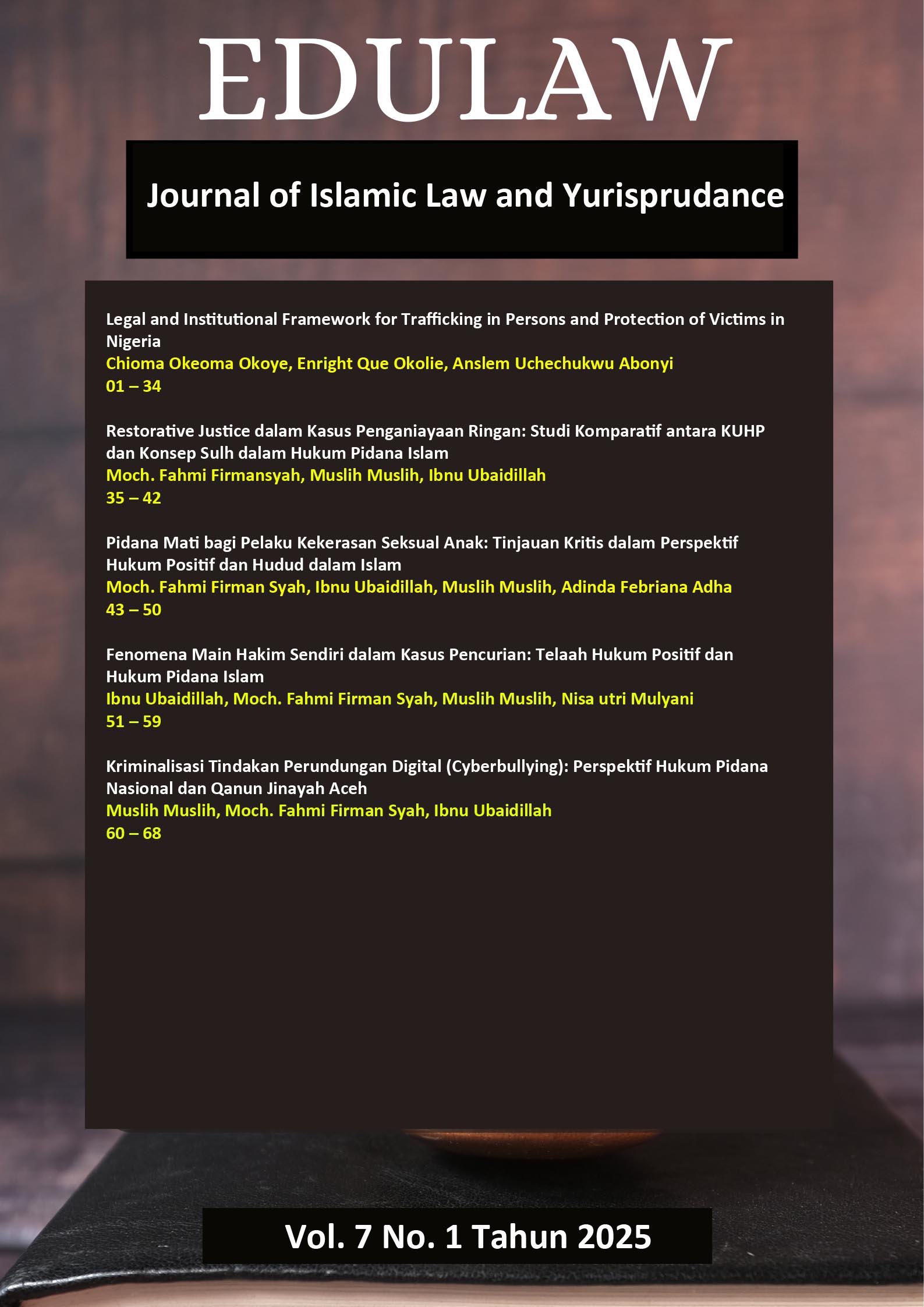
Legal and Institutional Framework for Trafficking in Persons and Protection of Victims in Nigeria
DOI:
https://doi.org/10.47453/edulaw.v7i1.3262Keywords:
Human trafficking, victims, victim protection, legal framework, NAPTIP, International conventionsAbstract
This study examines the legal and institutional frameworks addressing human trafficking and victim protection in Nigeria. The study focuses on the role of national laws, institutions, and international agreements in combating human trafficking and protecting victims’ rights. The study explores key legal instruments, such as the Constitution of the Federal Republic of Nigeria 1999 (amended), the Child’s Rights Act 2004, the Penal Code 2004, the Labour Act 2004, the Criminal Code Act 2004, and the Trafficking in Persons (Prohibition) Enforcement and Administration Act 2015. In addition, the study analyzes the roles of institutions such as the National Agency for the Prohibition of Trafficking in Persons (NAPTIP), the National Human Rights Commission (NHRC), the police, and civil society organizations in prevention, law enforcement, victim rescue, and advocacy. Nigeria is also committed to international legal frameworks, including the Palermo Protocol, the Convention on the Rights of the Child, and the Convention on the Elimination of All Forms of Discrimination against Women. This study uses a qualitative approach with a systematic review based on the PRISMA framework. The study results show that despite progress, major challenges remain, such as weak law enforcement, lack of coordination between institutions, and inadequate support for victims. Therefore, strengthening legal mechanisms and improving institutional coordination are important steps to build a more effective and humane response to human trafficking in Nigeria.
Downloads
References
Abdulkareem, Y. (2019). Improving protection and services for trafficking victims in the United States: Recommendations based on the United Kingdom's Modern Slavery Act 2015. Child Legal Rights Journal, 39, 131.
Abdul, Y. K., Wala, A. I., & Afolabi, A. (2023). The role of the judiciary in trafficking in persons and smuggling of migrants cases (TIP/SOM cases). AJLHR, 7, 106.
Abiodun, A. K., et al. (2017). Human trafficking: A global challenge reflection on the challenges in Nigeria. Journal of Law, Policy & Globalization, 61, 192.
Adeleke, F. A., & Olayanju, O. F. (2014). The role of the judiciary in combating corruption: Aiding and inhibiting factors in Nigeria. Commonwealth Law Bulletin, 40(4), 589-607.
Adeyemo, O. (2025). Dynamics of human trafficking in Oyo State, Nigeria. Journal of African Philosophy and Indigenous Knowledge System, 1(1), 32-41.
Afolabi, M. B. (2019). An appraisal of the impact of the National Agency for the Prohibition of Traffic in Persons (NAPTIP) and the role of Strategic Spiritual Intelligence (SSI). International Organisation of Scientific Research, 15-19.
Aina, K. (2014). The Nigerian police law. Princeton & Associates Publishing Company Ltd.
Akinwumi, O. S. (2010). Legal impediments on the practical implementation of the Child Right Act 2003. International Journal of Legal Information, 37(3), 10.
Akpotaire, C. (n.d.). Examining Nigeria's existing domestic and international legal framework for combating trafficking in children (TIC) [Doctoral dissertation, University of Leicester].
Amalu, N. S., & Adetu, M. O. (2019). The role of the National Human Rights Commission (NHRC) in post conflict situations in Nigeria. AFRREV IJAH: An International Journal of Arts and Humanities, 8(1), 132-142.
Amanze, M., Cahill, D., & Evans, C. (2022). Tackling human trafficking in governments supply chains: Legal certainty and effectiveness issues under the Australian commonwealth procurement rules model. Federal Law Review, 50(4), 479-503.
Anurioha, I. (2024). Child labor: The human trafficking exploitation in Nigeria. International Journal of Research and Innovation in Social Science, 8(2), 2283-2293.
Arinze-Umobi, C., Nwogu, K. C., & Ojobor, L. O. (2020). Examination of the institutional framework for combating trafficking in persons in Nigeria. IJOLACLE, 1, 54.
Babatunde, A. O. (2014). Human trafficking and transnational organized crime: Implications for security in Nigeria. Peace Research, 61-84.
Bello, P. O. (2018). Criminal justice response to human trafficking in Nigeria and South Africa: Suggestions for better performance. Contemporary Justice Review, 21(2), 140-158.
Bosma, A., & Rijken, C. (2016). Key challenges in the combat of human trafficking: Evaluating the EU Trafficking Strategy and EU Trafficking Directive. New Journal of European Criminal Law, 7(3), 315-330.
Burgers, J. H. (1988). The United Nations Convention against Torture: A handbook on the Convention against Torture and other cruel, inhuman, or degrading treatment or punishment. Martinus Nijhoff Publishers.
Cecchet, S. J., & Thoburn, J. (2014). The psychological experience of child and adolescent sex trafficking in the United States: Trauma and resilience in survivors. Psychological Trauma: Theory, Research, Practice, and Policy, 6(5), 482.
Charles, N. C., & Patricia, I. C. (2023). Trafficking of women and children vis-à-vis Trafficking in Persons (Prohibition) Law Enforcement and Administration Act 2015 and other relevant laws. Chukwuemeka Odumegwu Ojukwu University Journal of Private and Public Law, 5(1).
Child's Rights Act. (2003).
Cockbain, E., & Tompson, L. (2024). The role of helplines in the anti-trafficking space: Examining contacts to a major 'modern slavery' hotline. Crime, Law and Social Change, 1-30.
Constitution of the Federal Republic of Nigeria. (1999). https://nigeriarights.gov.ng/files/constitution.pdf
Convention on the Rights of the Child, Article 19. https://www.ohchr.org/en/instrumentsmechanisms/instruments/convention-rights-child
Davies, A. C. (2018). ILO Convention 181 Private Employment Agencies Convention, 1997 (No. 181). In International and European Labour Law (pp. 911-916). Nomos Verlagsgesellschaft mbH & Co. KG.
de Lang, N. E. (2012). The establishment and development of the Myanmar national human rights commission and its conformity with international standards. Asia-Pacific Journal on Human Rights and Law, 13, 1.
Dolinsek, S. (2023). Tensions of abolitionism of the prostitution of others. In Prostitution in Twentieth-Century Europe (pp. 103-128). Routledge.
Eze, H. U., Ogande, O. A., & Samuel, K. A. (2024). Assessment of NAPTIP communication strategies in curtailing gender-based human trafficking in FCT Abuja, Nigeria. International Journal of Sub-Saharan African Research, 2(4), 124-139.
Faso, B. (2012). International convention on the protection of the rights of all migrant workers and members of their families. Maharashtra Budget Analysis 2017–18.
Federal Republic of Nigeria v Patricia Ekhoe Igbinovia (aka Mama Bobby), FHC/L/345/2021 (unreported).
Foot, K. A., Toft, A., & Cesare, N. (2015). Developments in anti-trafficking efforts: 2008–2011. Journal of Human Trafficking, 1(2), 136-155.
Fouladvand, S. (2018). Decentering the prosecution-oriented approach: Tackling both supply and demand in the struggle against human trafficking. International Journal of Law, Crime and Justice, 52, 129-143.
General Assembly Resolution. (1993). Declaration on the Elimination of Violence against Women. United Nations.
Global Alliance against Traffic in Women. (n.d.). Human rights and trafficking in persons: A handbook. https://www.gaatw.org/books_pdf/Human%20Rights%20and%20Trafficking%20in%20Person.pdf
Hellum, A., et al. (2024). Nordic equality and anti-discrimination laws in the throes of change: Legal developments in Sweden, Finland, Norway, and Iceland. Taylor & Francis.
Huntley, S. S. (2013). The phenomenon of "baby factories" in Nigeria as a new trend in human trafficking. International Crimes Database.
Idris, A., et al. (2024). Community-based border policing: Towards complementing border surveillance strategy in countering human trafficking on the Nigeria–Niger border. Journal of Asian and African Studies, 00219096241228770.
Igbintade, W. (n.d.). THISDAYLIVE. https://www.thisdaylive.com
Igwe, D. O. (2023). Inter-agency collaboration against transnational crime and law enforcement within Seme Badagry Border migration corridor example. ESUT Journal of Social Sciences, 8(1).
Ikeora, M. (2018). Bilateral cooperation against trafficking: Nigeria and the United Kingdom. In Bilateral cooperation and human trafficking: Eradicating modern slavery between the United Kingdom and Nigeria (p. 217). Palgrave Macmillan.
Inherent dignity: An advocacy guidebook to preventing trafficking for the purpose of sexual exploitation and realizing the human rights of women and girls throughout their lives. Mercy International Association.
International Covenant on Civil and Political Rights. https://www.ohchr.org/en/instrumentsmechanisms/instruments/international-covenant-civil-and-political-rights
International Labour Organization. (1999). C182–Worst Forms of Child Labour Convention, 1999 (No. 182).
Iwuoha, L. N. (n.d.). Prevention of sex trafficking and perspectives from parents in Ogwa Community Edo State. https://www.academia.edu
Kigbu, S. K., & Hassan, Y. B. (2015). Legal framework for combating human trafficking in Nigeria: The journey so far. Journal of Law, Policy & Globalization, 38, 205-216.
Langtry, D., & Lyer, K. R. (2021). National human rights institutions: Rules, requirements, and practice. Oxford University Press.
Lerner, N. (1980). The UN Convention on the Elimination of All Forms of Racial Discrimination: A commentary. Brill.
Martin, C. (2020). National Human Rights Institutions in Southeast Asian states: The necessary foundation for an efficient ASEAN Intergovernmental Commission on Human Rights. National Human Rights Institutions in Southeast Asia: Selected Case Studies, 37-54.
Mayrhofer, M., et al. (2016). International human rights protection: The role of National Human Rights Institutions—A case study. FRAME.
Mbachu, C., Agwu, P., Obi, F., & Onwujekwe, O. (2024). Understanding and bridging gaps in the use of evidence from modeling for evidence-based policy making in Nigeria's health system. MDM Policy & Practice, 9(1), 23814683231225658.
Mihr, A. (2016). Non-governmental organizations in the human rights world. In The Ashgate research companion to non-state actors (pp. 377-390). Routledge.
Mika'il, U. S., & Muhammad, M. (2020). Nigerian trafficking in persons report: Lessons from policy implementation. CenRaPS Journal of Social Sciences, 2(1), 76-87.
Moreau, M. A. (2018). ILO Convention 29 Forced Labour Convention, 1930 (No. 29). In International and European Labour Law (pp. 1049-1073). Nomos Verlagsgesellschaft mbH & Co. KG.
Ndifon, C. O., Apori, K. A., & Ndifon, R. A. (2012). Human trafficking in Nigeria: A metaphor for human rights, crime and security violations. American Journal of Social Issues & Humanities, 2(3), 84-99.
Nigeria Country Report on Human Trafficking. (2019).
Nnaji, D. I., et al. (2024). Are civil society organizations doing enough? Mainstreaming civil society organisations in the administration of criminal justice in Nigeria. University of Nigeria Journal of Political Economy, 14(1).
Ojo, Y. A. (n.d.). The Guardian. https://guardian.ng/news/court-orders-remand-of-55-year-old-womanfor-alleged-humantrafficking/
Okene, O. V., & Akani, N. K. (2019). Human dignity and human rights: The Nigerian question. Australian Law Journal, 1, 7.
Okogbule, N. S. (2013). Combating the "new slavery" in Nigeria: An appraisal of legal and policy responses to human trafficking. Journal of African Law, 57(1), 57-80.
Olujuwon, T. (2008). Combating trafficking in person: A case study of Nigeria. European Journal of Scientific Research, 24(1), 23-32.
Oluwakemi, O. (2023). Enhancing effective judicial response to human trafficking in Nigeria. International Journal of Law and Social Sciences, 50-63.
Optional Protocol to the Convention on the Rights of the Child on the Sale of Children, Child Prostitution and Child Pornography, U.N. Doc. A/RES/54/262, 2171 U.N.T.S. 227 (2000).
Oyeyipo, O. M. (2024). Human trafficking as a continuing act of injustice in the Nigerian society. Global Journal of Educational Research, 23(3), 279-290.
Pais, M. S. (2010). The protection of children from sexual exploitation Optional Protocol to the Convention on the Rights of the Child on the Sale of Children, Child Prostitution and Child Pornography. The International Journal of Children's Rights, 18(4), 551-566.
Pendley, C. (n.d.). The United States Trafficking Victims Protection Act and States' compliance: An analysis.
Roots, K. (n.d.). Brief submitted to the House of Commons Standing Committee on Justice and Human Rights, review of the Protection of Communities and Exploited Persons Act (PCEPA) [Doctoral dissertation, Ryerson University].
Scarpa, S. (2020). UN Palermo trafficking protocol eighteen years on: A critique. The Palgrave International Handbook of Human Trafficking, 623-640.
Sheldon-Sherman, J. A. (2012). The missing P: Prosecution, prevention, protection, and partnership in the Trafficking Victims Protection Act. Penn State Law Review, 117, 443.
Shiman, I. D. (1993). Teaching human rights. Centre for Teaching International Relations Publications, University of Denver.
Temitope, A. E. (n.d.). Human trafficking and its implications for women in Edo State, Nigeria [Master's thesis, Kwara State University].
Thomann, L. (2011). The abolition of forced and compulsory labour. In Steps to compliance with international labour standards: The International Labour Organization (ILO) and the abolition of forced labour (pp. 185-242). VS Verlag für Sozialwissenschaften.
Toyo, N. (2013). Revisiting equality as a right: The minimum age of marriage clause in the Nigerian Child Rights Act, 2003. In The politics of rights (pp. 125-138). Routledge.
Trafficking in Persons (Prohibition) Enforcement and Administrative Act. (2015).
Traglia, F. P. (2020). From transition to government accountability: Opportunities for the Myanmar National Human Rights Commission. National Human Rights Institutions in Southeast Asia: Selected Case Studies, 121-140.
Umejiaku, N. U. (2020). Protection of children from pornography: An appraisal. NIALS Journal of Public Law, 2(2), 194-218.
Umozurike, U. O. (2023). The African Charter on Human and Peoples' Rights. Brill.
United Nations Convention against Transnational Organized Crime and the Protocols Thereto. https://www.unodc.org/unodc/en/organized-crime/intro/UNTOC.html
UN General Assembly. (1989). Convention on the Rights of the Child. United Nations Treaty Series, 1577(3), 1-23.
Van der Wilt, H. (2014). Trafficking in human beings, enslavement, crimes against humanity: Unravelling the concepts. Chinese Journal of International Law, 13(2), 297-334.
Walby, S., et al. (2016). Study on comprehensive policy review of anti-trafficking projects funded by the European Commission: HOME/2014/ISFP/PR/THBX/0052. Publications Office of the European Union.
Women UN. (1979). Convention on the elimination of all forms of discrimination against women. http://www.un.org/womenwatch/daw/cedaw/text/econvention.htm
Zoglin, K. (1986). United Nations action against slavery: A critical evaluation. Human Rights Quarterly, 8, 306.
Additional Files
Published
Issue
Section
License
Copyright (c) 2025 Authors

This work is licensed under a Creative Commons Attribution-NonCommercial-ShareAlike 4.0 International License.