Teaching Number Concepts: A Pedagogical Content Knowledge (PCK) Analysis of Pre-service Early Childhood Teachers
DOI:
https://doi.org/10.47453/hadlonah.v7i1.4037Keywords:
Pedagogical Content Knowledge (PCK), Number Sense, Early Childhood EducationAbstract
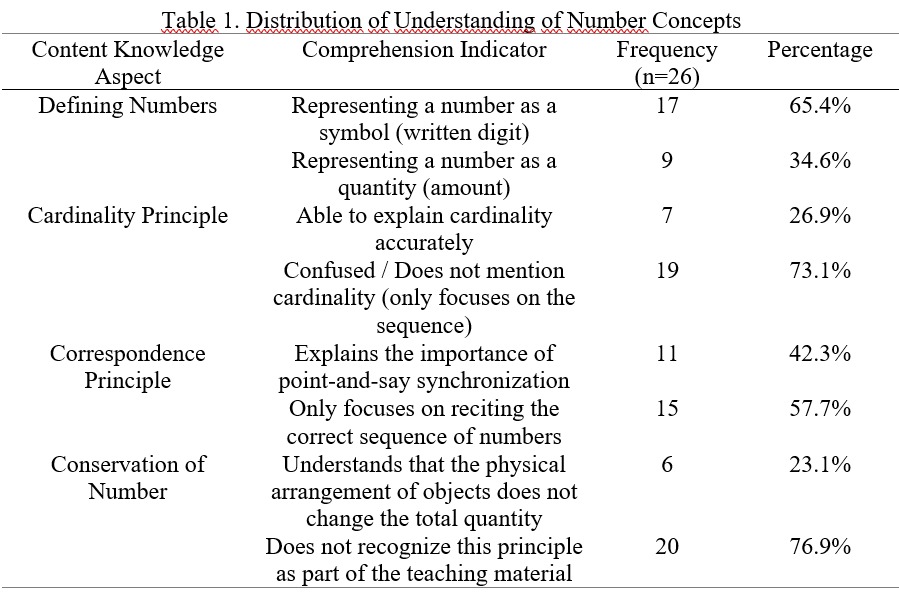
This study presents a comprehensive analysis of the Pedagogical Content Knowledge (PCK) profiles of 26 pre-service early childhood teachers regarding the teaching of number sense. The research is motivated by the urgency of mastering early mathematical literacy as a child's cognitive foundation, which is often hindered by teachers' limited pedagogical competence in transforming abstract content into concrete learning. Using a qualitative case study design, data were collected through Content Representation (CoRe) instruments, Pedagogical and Professional-experience Repertoires (PaP-eRs), analysis of Daily Lesson Plans (RPPH), and microteaching observations. The analysis assessed the mastery of Subject Matter Knowledge (SMK), covering Gelman and Gallistel’s counting principles (one-to-one correspondence, stable order, cardinality, abstraction, and order irrelevance), as well as PCK components including Knowledge of Content and Students (KCS) and Knowledge of Content and Teaching (KCT). The results revealed significant PCK profiles: 38.5% at the Pre-PCK level, 50% at the Growing PCK level, and only 11.5% reaching Maturing PCK. Key findings indicate that although the pre-service teachers possess adequate procedural knowledge regarding number sequences, there is a profound conceptual deficit in cardinality and one-to-one correspondence. Consequently, they tend to design drill-oriented, worksheet-based learning activities. Furthermore, the KCS ability to anticipate children's misconceptions was identified as the weakest aspect, as the prospective teachers often failed to detect subtle counting errors in children.
Downloads
References
Achiam, M., & Winslow, C. (2020). Educational design in math and science: The collective aspect. https://www.ind.ku.dk/english/course_overview/PhD_Courses/collective/
Aini Amalia Sari, N., Azka, R., Iqna Hibatallah, M., Studi Pendidikan Matematika, P., & Islam Negeri Sunan Kalijaga Yogyakarta, U. (2023). Analisis Kompetensi Pedagogik Calon Guru Matematika Melalui Implementasi Lesson Study Dalam PLP. Journal in Mathematics Education, 3(2), 63-69, https://doi.org/10.14421/polynom.2023.32.63-69
Andika, W. D., Utami, F., Alrefi, A., Sumarni, S., Siregar, R. R., Sari, R. C., & Hasan, N. I. (2024). Exploring Early Childhood Counting Principles. In Proceedings of the 7th International Conference on Learning Innovation and Quality Education (ICLIQE 2023) (pp. 272–290). Advances in Social Science, Education and Humanities Research. https://doi.org/10.2991/978-2-38476-301-6_26
Astuti, F. P., & Rasidi. (2020). Persepsi Guru Tentang standar Pembelajaran Matematika Di Tk Di Kabupaten Magelang. Jurnal Penelitian Dalam Bidang Pendidikan Anak Usia Dini (PAUDIA), 9(1), 111–125. https://doi.org/https://doi.org/10.26877/paudia.v9i1.6233
Biba, L., Ngura, E. T., & Laksana, D. N. L. (2024). Analisis Kemampuan Literasi dan Numerasi Dasar Anak Usia Dini di Paud Boasiko. Jurnal Citra Pendidikan Anak, 3(3), 1122–1133. https://doi.org/10.38048/jcpa.v3i3.3231
Fadhilah, P. R. N., & Rocmah, L. I. (2025). Worm Pick Media Increases Early Childhood Numeracy Achievement. Academia Open, 10(1). https://doi.org/10.21070/acopen.10.2025.12774
Irawan, Y., Purnamasari, I., Asfifah, R. M., Karami, Y., & Alfiah, S. (2021). Analisis Kompetensi Pedagogical Content Knowledge Mahasiswa Calon Guru Matematika. Himpunan: Jurnal Ilmiah Mahasiswa Pendidikan Matematika, 1 (1), 63-76.
Marshman, M., & Porter, G. (2022). Pre-service Teachers’ Pedagogical Content Knowledge: Implications for Teaching. Proceedings of the 36th Annual Conference of the Mathematics Education Research Group of Australasia, 474-481, https://files.eric.ed.gov/fulltext/ED572978.pdf
McCray, J. S., & Qi Chen, J. (2022). Pedagogical Content Knowledge for Preschool Mathematics: Construct Validity of a New Teacher Interview. Journal of Research in Childhood Education, 1(26), 291–307. https://doi.org/10.1080/02568543.2012.685123
Muhlisin, & Lestari, K. (2023). Penerapan Konsep Matematika Pada Anak Usia Dini. https://doi.org/https://doi.org/10.46368/mkjpaud.v3i2.1933
Noviyanti, M., & Suryadi, D. (2019). Conceptualizing mathematical knowledge for teaching of Indonesian teacher in teaching number sense to early childhood. Journal of Physics: Conference Series, 1157(3). https://doi.org/10.1088/1742-6596/1157/3/032121
Permendikbud No 146. (2014). Peraturan Menteri Pendidikan Dan Kebudayaan Republik Indonesia.
Pincheira, N., & Alsina, Á. (2022). Mathematical Knowledge of Pre-Service Early Childhood and Primary Education Teachers: An Approach Based on the Design of Tasks Involving Patterns. Australian Journal of Teacher Education, 47(8), 50–69. https://doi.org/10.14221/ajte.2022v47n8.4
Prayitno, L. L., Mutianingsih, N., & Insani, A. (2023). Membangun Number Sense pada Anak TK A berdasarkan sudut pandang Semantik. Jurnal Obsesi : Jurnal Pendidikan Anak Usia Dini, 7(6), 7525–7536. https://doi.org/10.31004/obsesi.v7i6.4460
Putri, A. D. (2018). Profil Kompetensi Pedagogik Calon Guru Matematika Melalui Lesson Study Pada Mata Kuliah Micro Teaching. Jurnal Pendidikan Matematika RAFA, 4(1), 1–8. https://doi.org/2460-8726
Quilang, L. J. L. (2023). Pedagogical Content Knowledge of Pre-Service Mathematics Teachers Leading to Continual Improvement. Journal for Educators, Teachers and Trainers, 14(5). https://doi.org/10.47750/jett.2023.14.05.015
Rahmawati, M. S., & Amri, I. (2020). The Role of Parents at Mathematics Learning Innovation in Early Education. Indonesian Journal of Early Childhood Education Studies, 9(1), 40–47. https://doi.org/10.15294/ijeces.v9i1.38349
Rohmalina, & Komala. (2019). Meningkatkan Kemampuan Pemahaman Konsep Bilangan Anak Usia Dini Kelompok B Melalui Metode Open Ended. Jurnal Tunas Siliwangi, 105-110.
Rohmalina, R., Aprianti, E., & Lestari, R. H. (2020). Pendekatan Open-Ended dalam Mempengaruhi Kemampuan Mengenal Konsep Bilangan Anak Usia Dini. Jurnal Obsesi : Jurnal Pendidikan Anak Usia Dini, 5(2), 1409–1418. https://doi.org/10.31004/obsesi.v5i2.805
Simatupang, N. D., Sholichah, S. A., & Simanjuntak, I. A. (2023). Introduction to Counting Symbols in Early Childhood with Stick Math (STIKMA) Educational Tool Games. JPUD - Jurnal Pendidikan Usia Dini, 17(2), 297–311. https://doi.org/10.21009/jpud.172.08
Siregar, T. (2025). Examining the Dimensions of Mathematical Knowledge for Teaching among Preservice Elementary Teachers. https://doi.org/10.20944/preprints202510.1765.v1
Soendergaard, B. D., & Cachaper, C. (2020). Teaching mathematics effectively to primary students in developing countries: Insights from neuroscience and psychology of mathematics. Global Partnership for Education, 1-62, https://doi.org/10.1596/28116
Suharto, D., Nurdin, E. S., & Waluya, B. (2022). Pengembangan Kompetensi Pedagogical Content Knowledge pada Mahasiswa Calon Guru dalam Kegiatan Magang Bersertifikat Kampus Merdeka di Global Islamic Boarding School Yayasan Hasnur Centre. Jurnal Penelitian Pendidikan, 22(2), 182–197. https://doi.org/10.17509/jpp.v22i2.50036
Supriyanto. (2025). Urgensi Pengenalan Literasi Numerasi pada Anak Usia Dini: Dampak terhadap Kemampuan Matematika di SD dan Kesiapan Sekolah. https://doi.org/https://doi.org/10.51675/alzam.v5i1.1093
Wahyuni, I. (2022). Analisis Kemampuan Literasi Numerasi Berdasarkan Gaya Belajar pada Anak Usia Dini. Jurnal Obsesi : Jurnal Pendidikan Anak Usia Dini, 6(6), 5840–5849. https://doi.org/10.31004/obsesi.v6i6.3202
Wicaksono, B., & Dwipa, N. M. S. (2020). PCK (Pedagogical Content Knowledge) profile of mathematics education students at Universitas PGRI Yogyakarta. Journal of Physics: Conference Series, 1538(1). https://doi.org/10.1088/1742-6596/1538/1/012108
Yaswinda, & Gusmarni. (2022). Analisis Permendikbud Nomor 137 Dan 146 Dalam Pembelajaran Paud. Jurnal Ilmiah PTK PNF, 17(2), 70–76. https://doi.org/doi.org/10.21009/JIV.1702.8
Yunianto, W., Indra Prahmana, R. C., & Crisan, C. (2021). Indonesian mathematics teachers’ knowledge of content and students of area and perimeter of rectangle. Journal on Mathematics Education, 12(2), 223–238. https://doi.org/10.22342/JME.12.2.13537.223-238