Natural Environment Based Science Learning to Improve Critical Thinking and Creativity Skills in Early Childhood
DOI:
https://doi.org/10.47453/hadlonah.v7i1.4040Keywords:
science learning, critical thinking, creativity, natural enviroment, early childhood educationAbstract
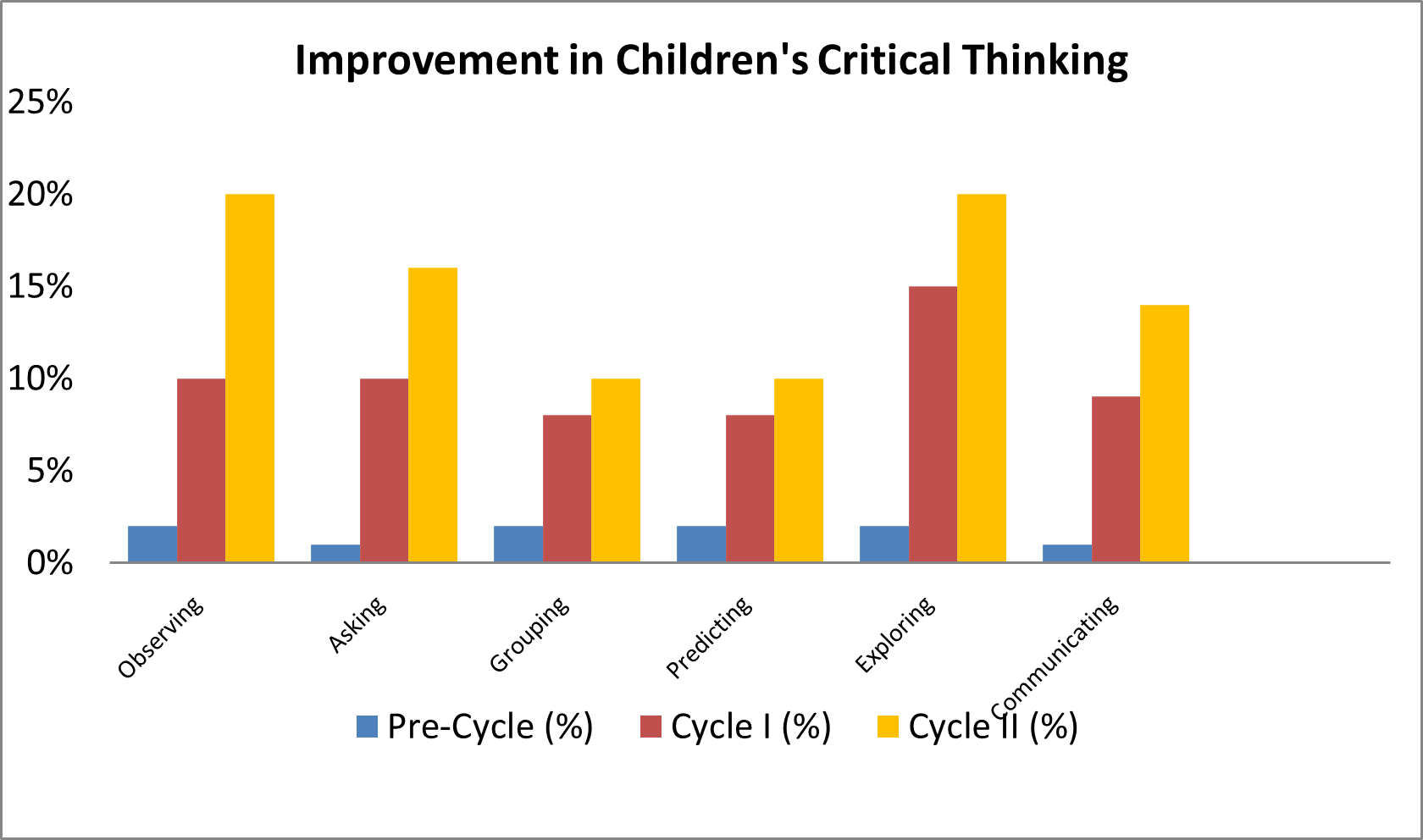
Science learning in early childhood education is still predominantly instructional and teacher-centered, resulting in limited meaningful learning experiences for children. This condition contributes to the low levels of critical thinking and creativity, which are essential 21st-century competencies. This study aimed to improve early childhood critical thinking and creativity through the implementation of nature- based science learning. The study used a two-cycle implementation of the Classroom Action Research (CAR) method based on the Kemmis and McTaggart model; each cycle had the following steps: preparation; action; observation; and reflection. The research subjects were 15 children aged 4–6 years at TK Darul Quran, Sumedang Regency. Data were collected through observation, documentation, and reflective notes using observation sheets to assess children's critical thinking and creativity skills. Data analysis was conducted using descriptive quantitative and qualitative approaches. The results showed that children's critical thinking skills increased from 10% in the pre-cycle to 60% in Cycle I and 90% in Cycle II. Similarly, creativity skills improved from 20% to 65% and 92%, respectively. These findings indicate that nature-based science learning can in enhancing critical thinking and creativity in early childhood education.
Downloads
References
Ahmad Susanto. (2021). Pendidikan Anak Usia Dini: Konsep dan Teori. Bumi Aksara.
Ardoin, N. M. (2020). Environmental education outcomes for conservation: A systematic review. Biological Conservation. 241, 108224. doi: https://doi.org/10.1016/j.biocon.2019.108224
Arikunto, S. &. (2016). Penelitian Tindakan Kelas . Bumi Aksara
Arikunto, S. (2013). Dasar-Dasar Evaluasi Pendidikan. Jakarta: Bumi Aksara.
Astuti, R. &. (2019). Integrasi Pengembangan Kreativitas Anak Usia Dini di TK Kanisius Sorowajan Yogyakarta. Jurnal Obsesi Pendidikan Anak Usia Dini, 294.
Azizah, N., Ismaiyah, N., & Nisa, K. (2023). The application of nature-based early childhood education curriculum. JOYCED: Journal of Early Childhood Education, 3(1). https://doi.org/10.14421/joyced.2023.31-01
Campbell, A., & Speldewinde, C. (2023). Designing school grounds for nature-based learning: A review of the evidence. Journal of Outdoor and Environmental Education, 27, 437–468.
Chan, Z. C. (2018). A systematic review on critical thinking in medical education. International. Journal of Adolescent Medicine and Health, 30(1). doi: https://doi.org/10.1515/ijamh-2015-0117
Devianti, R. S. (2020). Pendidikan Karakter untuk Anak Usia Dini. MITRA ASH-SHIBYAN. Jurnal Pendidikan Dan Konseling,, 3(02)(67–78.). doi: https://doi.org/10.46963/mash.v3i02.150
Endang Rahayu, I. D. (2026). Perencanaan Pembelajaran Berbasis Proyek untuk Meningkatkan Kreativitas Anak Usia Dini. Indonesian Journal Of Education,, 2(3)(566–572.). doi: https://doi.org/10.71417/ije.v2i3.1495
Eshach, H. &. (n.d.). Should Science be Taught in Early Childhood. Journal of Science Education and Technology, 14(3)(315–336.). doi: https://doi.org/10.1007/s10956-005- 7198-9
Facione, P. A. (2015). Permission to Reprint for Non-Commercial Uses Critical Thinking: What It Is and Why It Counts. (Peter A. Facione, Ed.) Measured Reasons LLC.
Fleer, M. &. (2015). A cultural-historical study of children learning.
Gill, T. (2014). The benefits of children’s engagement with nature: A systematic literature review. Children, Youth and Environments,, 24(2)(10–34.).
Helen R Quinn at all. (2012). A framework for K-12 science education : practices, crosscutting concepts, and core ideas. The National Academies Press.
Husna, A. d. (2021). Strategi Perkembangan dan Indikator Pencapaian Bahasa Reseptif dan Bahasa Ekspresif pada Anak Usia Dini. Jurnal Family Education, 1(4)(38- 46).
Johnson, E. B. (2002). Contextual Teaching and Learning: What It is and Why It’s Here to Stay. California: Corwin Press.
Karwowski, M. &. (2019). Creative behavior as agentic action. Psychology of Aesthetics, Creativity, and the Arts,, 13(4)(402–415.). doi:https://doi.org/10.1037/aca0000190
Kiviranta, L. L.-L. (2024). Outdoor learning in early childhood education exploring benefits and challenges. . Educational Research, 66(1)(102–119.). doi: https://doi.org/10.1080/00131881.2023.2285762
Kuo, M. B. (2019). Do experiences with nature promote learning? Converging evidence of a cause-and-effect relationship. Frontiers in Psychology, 10(305). doi:https://doi.org/10.3389/fpsyg.2019.00305
Lindfors, E. R.-L. (2010). Outdoor Learning in Early Childhood Education A Narrative Review. (Number 2).
Likert, R. (1932). A Technique for the Measurement of Attitudes. Archives of Psychology.
NIU, W. &. (2002). Contemporary Studies on the Concept of Creativity: the East and the West. The Journal of Creative Behavior,, 36(4)(269–288. ). doi: https://doi.org/10.1002/j.2162-6057.2002.tb01069.x
OECD. (2023). PISA 2022 results (Volume I): The state of learning and equity in education. OECD Publishing.
Parnawi, A. (2020). Penelitian Tindakan Kelas (Classroom Action Research). Deepublish Publisher.
Permatasari, dkk. (2025). The Implementation of Nature-Based Learning to Foster Creativity and Independence in Early Childhood. Journal Nak-Kanan of child research. 2 (2) (71-80) doi: https://doi.org/10.21107/njcr.v2i2.148
Piaget, J. (1974). To understand is to invent : the future of education. Viking Press.
Prins, J. v. (2022). Nature play in early childhood education: A systematic review and meta ethnography of qualitative research. Frontiers in Psychology, 13. doi:https://doi.org/10.3389/fpsyg.2022.995164
Rickinson, M. (2001). Learners and Learning in Environmental Education: A critical review of the evidence. Environmental Education Research, 7(3)(207–320.). doi:https://doi.org/10.1080/13504620120065230
Sobel, D. .. (2004). Place-based education: Connecting classrooms and communities. Orion Society.
Sugiyono. (2019). Metode Penelitian Kuantitatif, Kualitatif, dan R&D. Bandung: Alfabeta
Suryadi. (2025). The role of nature-based learning in developing early childhood creativity. Jurnal E-MAS (Edukasi dan Pembelajaran Anak Usia Dini), 1(1), 23–33. https://doi.org/10.64690/e-mas.v1i1.29
Torrance, E. P. (1974). Torrance tests of creative thinking : norms-technical manual. Scholastic Testing Service.
Trina, N. A., Monsur, M., Cosco, N., Shine, S., Loon, L., & Mastergeorge, A. (2024). How do nature-based outdoor learning environments affect preschoolers’ STEAM concept formation? A scoping review. Education Sciences, 14(6), 627. https://doi.org/10.3390/educsci14060627
UNESCO. (2023). Global education monitoring report, 2023 . technology in education: a tool.
UNICEF. (2025). Ending Child Poverty: Our shared imperative. UNICEF.
Utami, D. T. (2020). Outbound as an Effective Method to Enhance Social Skills in Children Aged 5-6 Years. ARTICLE INFORMATION ABSTRACT.
Vygotsky, L. S. (1978). Mind in society: The development of higher psychological processes. 86.
Wilson, R. (2012). Nature and young children: Encouraging creative play and learning in natural environments. New York: Routledge.
Yaswinda, Y., et al. (2020). Pembelajaran sains berbasis eksplorasi pada anak usia dini. Jurnal Pendidikan Anak Usia Dini, 14(2), 123–135. https://doi.org/xxxxx
Yaswinda, Y. P. (223). Pembelajaran Sains Berbasis Pemanfaatan Lingkungan untuk Peningkatan Kognitif Anak Usia Dini. Jurnal Obsesi : Jurnal Pendidikan Anak Usia Dini, 7(1)(94–103.). doi:https://doi.org/10.31004/obsesi.v7i1.2842
Zizan, I. K. (2024). Application of Inquiry Learning to Improve Critical Thinking Skills of 5-6 Year Old Children. doi: https://doi.org/10.21070/ups.5609
Zohar, A. &. (2023). Higher Order Thinking Skills and Low-Achieving Students Are They Mutually Exclusive. Journal of the Learning Sciences, 12(2), (145–181). doi: https://doi.org/10.1207/S15327809JLS1202_1