Social and Digital Ecology: The Impact of the School Environment, Peer Interaction, and Gadget Exposure on Children's Psychological Well-being
DOI:
https://doi.org/10.47453/hadlonah.v7i1.4088Keywords:
Gadget usage, Peers, Psychological Well-being, School EnvironmentAbstract
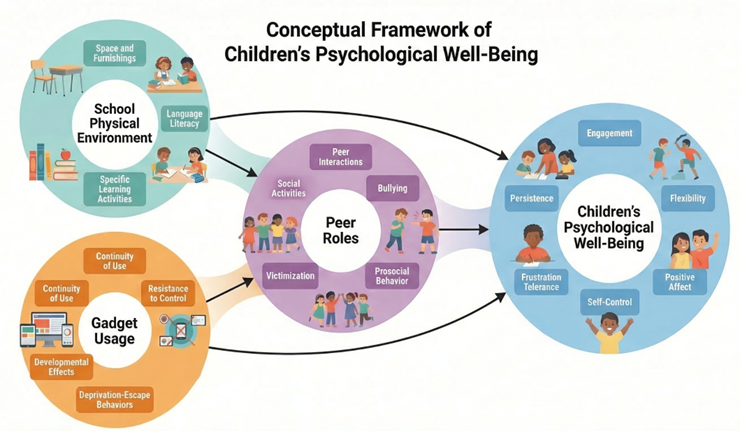
Psychological well-being during early childhood is a critical component in fostering social and emotional development during this pivotal growth phase. Nevertheless, increased exposure to electronic devices and variations in the quality of the school environment may influence children's psychological states. This study seeks to examine the impact of the physical school environment and gadget usage on children's psychological well-being, considering the mediating role of peer interactions. The research utilized a quantitative survey methodology, engaging 304 mothers of children aged 4–6 years who are enrolled in 19 kindergartens within the Bogor Barat District. Data analysis was conducted using SPSS and SEM via SmartPLS 4. The findings indicate that the physical school environment positively affects children's psychological well-being and enhances the role of peers. Conversely, gadget usage negatively impacts peer interactions and children's psychological well-being. The role of peers was found to significantly enhance children's psychological well-being. Consequently, achieving a balance between the quality of the school environment, the regulation of gadget usage, and social support from peers is essential in promoting the mental health of young children.
Keywords: gadget usage, peers, psychological well-being, school environment
Downloads
References
Beaumont, J., Putwain, D. W., Gallard, D., Malone, E., Marsh, H. W., Pekrun, R., … Malone, E. (2023). Students’ emotion regulation and school-related well-being: longitudinal models juxtaposing between- and within-person perspectives. Journal of Educational Psychology, 115(7), 932–950. https://doi.org/https://doi.org/10.1037/edu0000800.
Bronfenbrenner, U. (1979). The ecology of human development: Experiments by nature and design. Harvard University Press.
Butler, N., Quigg, Z., Bates, R., Jones, L., Ashworth, E., Gowland, S., & Jones, M. (2022). The contributing role of family , school , and peer supportive relationships in protecting the mental wellbeing of children and adolescents. School Mental Health, 14(3), 776–788. https://doi.org/10.1007/s12310-022-09502-9
Chen, C. (2024). The influence of peer relationships on children’s social development. Lecture Notes in Education Psychology and Public Media, 45(1), 221–225. https://doi.org/10.54254/2753-7048/45/20230544
Habiby, M. N. A., Mutiasari, D., Yunus, C. W., Malang, U. N., Raya, U. P., Mercu, U., & Yogyakarta, B. (2025). Dampak penggunaan gadget terhadap interaksi sosial anak di masyarakat pada era digital (Studi pada masyarakat Daerah Yogyakarta). AL-DYAS: Jurnal Inovasi Dan Pengabdian Kepada Masyarakat, 4(04), 974–1005. https://doi.org/https://doi.org/10.58578/aldyas.v4i2.5553 DAMPAK
Haddow, S., Taylor, E. P., & Schwannauer, M. (2021). Positive peer relationships, coping and resilience in young people in alternative care: A systematic review. Children and Youth Services Review, 122(8), 1–37. https://doi.org/10.1016/j.childyouth.2020.105861
Harms, T., Crayer, D., Clifford, R., & Yazejian, N. (2022). amily Child Care Environment Rating Scale, third edition (FCCERS-3). Lincoln (NE): Nebraska Department of Education.
Hawkins, G. T., Chung, C. S., Hertz, M. F., & Antolin, N. (2023). The school environment and physical and social-emotional well-being: Implications for students and school employees. Journal of School Health, 93(9), 799–812. https://doi.org/10.1111/josh.13375
Hnin, H. M., & Kim, Y. H. (2022). The mediating role of peer attachment between affective school environment and children’s behavior problems. Family and Environment Research, 60(4), 497–505. https://doi.org/http://dx.doi.org/10.6115/fer.2022.033
Jain, P. (2025). The impact of smartphone addiction on social skills and play behaviour among. International Journal of Innovations In Science Engineering And Management, 4(1), 1–7. https://doi.org/10.69968/ijisem.2025v4i101-07
Kaur, N., Gupta, M., Kiran, T., Malhi, P., & Grover, S. (2021). Development and evaluation of the digital- screen exposure questionnaire ( DSEQ ) for young children. Plos One, 16(6), 1–15. https://doi.org/10.1371/journal.pone.0253313
Kumulloh, Y., & Nurhafizah. (2022). Impact of gadget use on emotional development of children aged 5-6 years in Khairunnisa Kindergarten. EduBasic Journal: Jurnal Pendidikan Dasar, 4(1), 85–96. https://doi.org/10.17509/ebj.v4i1.45574
Kwon, S., Armstrong, B., Wetoska, N., & Capan, S. (2024). Screen Time , Sociodemographic Factors , and Psychological Well-Being Among Young Children. Screen Time , Sociodemographic Factors , and Psychological Well-Being among Young Children, 7(3), 1–12. https://doi.org/10.1001/jamanetworkopen.2023.54488
Laboy, M. (2019). Physical environments for active schools: Future directions for transdisciplinary research. Translational Journal of the American College of Sports Medicine, 4(17), 155–164. https://doi.org/10.1249/tjx.0000000000000097
Lee, H., & Lim, J. (2024). The longitudinal mediating role of peer attachment in the relationship between affective school environment and children’s sense of community. Human Ecology Research, 62(2), 249–259. https://doi.org/http://doi.org/10.6115/her.2024.017
Mann, J., Gray, T., Truong, S., Brymer, E., Passy, R., Ho, S., … Mann, J. (2022). Getting out of the classroom and into nature : a systematic review of nature-specific outdoor learning on school children ’ s learning and development. Frontiers in Public Health, 10(5), 1–12. https://doi.org/10.3389/fpubh.2022.877058
Marciano, L., Ostroumova, M., Schulz, P. J., & Lorenzo, G. Di. (2022). Digital media use and adolescents’ mental health during the covid-19 pandemic: a systematic review and meta-analysis. Frontiers in Public Health, 9(2), 1–28. https://doi.org/10.3389/fpubh.2021.793868
Muppalla, S. K., Vuppalapati, S., Pulliahgaru, A. R., & Sreenivasulu, H. (2023). Effects of excessive screen time on child development : an updated review and strategies for management. Cureus 15(6):, 15(6), 1–5. https://doi.org/10.7759/cureus.40608
Nurhidayah, S., Ekasari, A., Muslimah, A. I., Pramintari, R. D., & Hidayanti, A. (2021). Dukungan sosial, strategi koping terhadap resiliensi serta dampaknya pada Kesejahteraan psikologis remaja yang orangtuanya bercerai. Paradigma, 18(1), 61–77.
Nurmayanti, A. I., Prasetyawan, R. D., & Iswahyudi, U. A. (2024). Dampak penggunaan gadget terhadap tumbuh kembang anak usia balita: Literatur review. Nursing Information Journal, 4(1), 38–48. https://doi.org/https://doi.org/10.54832/nij.v4i1.837
Obi, C., Ideba, M., Manyo, C., Joseph, K., Ilhami, A., Ukah, J., … Edet, U. (2023). Learning space, students’ collaboration, educational outcomes, and interest: Exploring the physical, social and psychological mediators. Heliyon, 9(4), e15456. https://doi.org/10.1016/j.heliyon.2023.e15456
Panjeti-madan, V. N., & Ranganathan, P. (2023). Impact of screen time on children ’ s development : Cognitive, language, physical, and social and emotional domains. Multimodal Technologies and Interaction Review, 7(52), 1–30. https://doi.org/https://doi.org/10.3390/mti7050052
Podiya, J. K., Navaneetham, J., & Bhola, P. (2025). Influences of school climate on emotional health and academic achievement of school- going adolescents in India : a systematic review. BMC Public Health, 25(54), 1–14. https://doi.org/https://doi.org/10.1186/s12889-024-21268-0
Reinius, H., Korhonen, T., & Hakkarainen, K. (2021). The design of learning spaces matters : perceived impact of the deskless school on learning and teaching. Learning Environments Research, 24(3), 339–354. https://doi.org/10.1007/s10984-020-09345-8
Rigby, K., & Slee, P. T. (1993). Dimensions of interpersonal relation among australian children and implications for psychological well- being. The Journal of Social Psychology, 133(1), 37–41. https://doi.org/10.1080/00224545.1993.9712116
Ryff, C. D., & Keyes, C. L. M. (1995). The structure of psychological well-being revisited. Journal of Personality and Social Psychology, 69(4), 719–727. https://doi.org/10.1037/0022-3514.69.4.719
Shen, Y., Zhou, Y., Ren, S., Li, Y., Liu, Y., Zhou, R., … Guangping, X. (2025). Relations between peer bullying and adolescent depression : the mediating effect of cellphone usage. Frontiers in Psychatry, 16(1486628.), 1–8. https://doi.org/10.3389/fpsyt.2025.1486628
Shum, C., Dockray, S., Gallagher, S., & Mcmahon, J. (2025). Social – emotional competencies and psychological being across secondary school transition. British Journal of Developmental PsychologYu, 43(4), 922–942. https://doi.org/10.1111/bjdp.12564
Situmorang, K., Milfayetty, S., & Hasanuddin. (2024). Pengaruh religiusitas terhadap kesejahteraan psikologis dengan dukungan sosial teman sebaya sebagai variabel moderasi. Al Qalam: Jurnal Ilmiah Keagamaan Dan Kemasyarakatan, 18(6), 4144–4155. https://doi.org/https://jurnal.stiq-amuntai.ac.id/index.php/al-qalam P-ISSN:
Smith, K., Asantewa, J., AndohKwaw, P., & Ampaw, E. O. (2024). Influence of physical features of ohusing environment on students halls of residence. Universal Journal of Business and Management, 4(1), 28–42. https://doi.org/10.31586/ujbm.2024.1162
Xu, X., Han, W., & Liu, Q. (2023). Peer pressure and adolescent mobile social media addiction : Moderation analysis of self-esteem and self-concept. Frontiers in Public Health, 11(4), 1–9. https://doi.org/10.3389/fpubh.2023.1115661
Yang, Jhu-ting, Chen, C., & Zheng, M.-C. (2023). Elevating children ’ s play experience : a design intervention to enhance children ’ s social interaction in park playgrounds. Sustainability, 15(6971), 1–18. https://doi.org/https://doi.org/10.3390/su15086971
Yang, Jianhui, Guozhi, A., & Wang, M. (2023). Research on the impact of school physical education environment on adolescent peer relationships. Applied & Educational Psychology, 4(7), 11–19. https://doi.org/10.23977/appep.2023.040702