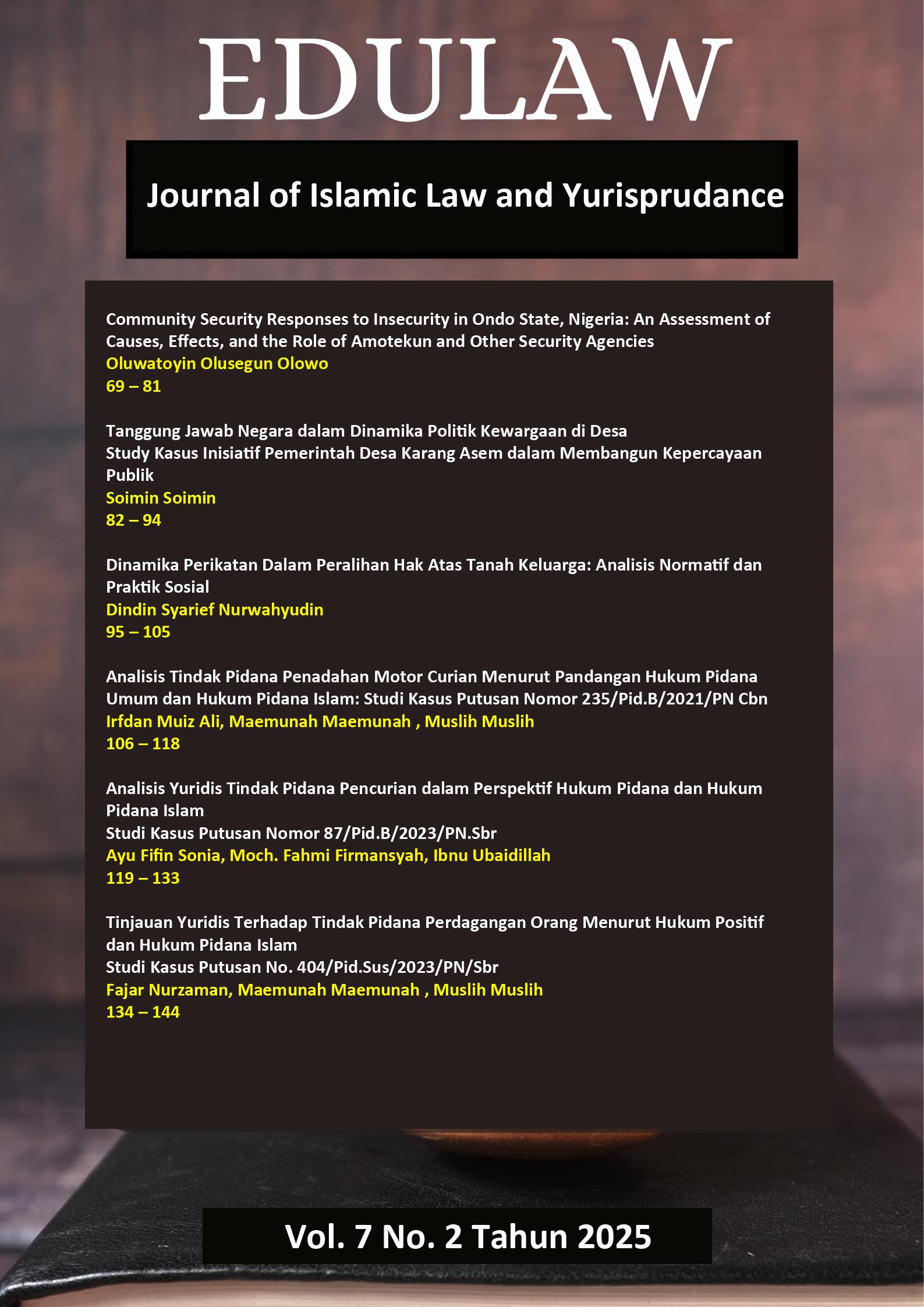
Dinamika Perikatan Dalam Peralihan Hak Atas Tanah Keluarga: Analisis Normatif dan Praktik Sosial
DOI:
https://doi.org/10.47453/edulaw.v7i2.3557Kata Kunci:
Obligation; Family Land; Notary.Abstrak
This study discusses the dynamics of obligations in the transfer of family land rights by highlighting the tension between positive legal norms and social practices. Normatively, the transfer of land rights must fulfill the requirements of an agreement as stipulated in the Civil Code, be set forth in an authentic deed, and be registered in accordance with the provisions of the Basic Agrarian Law (UUPA) and Government Regulation No. 24 of 1997. However, in practice, transfers are often carried out in a simple manner through oral grants, private agreements, or customary family arrangements based on mutual trust. This phenomenon creates legal vulnerability and has the potential to trigger land disputes. This research employs a normative-sociolegal approach with qualitative analysis to examine land regulations as well as social practices. The findings indicate the need for legal harmonization between formal certainty and family values, positioning notaries/land deed officials (PPAT) not only as administrative officers but also as legal educators who bridge formal law with the This study discusses the dynamics of obligations in the transfer of family land rights by highlighting the tension between positive legal norms and social practices. Normatively, the transfer of land rights must fulfill the requirements of an agreement as stipulated in the Civil Code, be set forth in an authentic deed, and be registered in accordance with the provisions of the Basic Agrarian Law (UUPA) and Government Regulation No. 24 of 1997. However, in practice, transfers are often carried out in a simple manner through oral grants, private agreements, or customary family arrangements based on mutual trust. This phenomenon creates legal vulnerability and has the potential to trigger land disputes. This research employs a normative-sociolegal approach with qualitative analysis to examine land regulations as well as social practices. The findings indicate the need for legal harmonization between formal certainty and family values, positioning notaries/land deed officials (PPAT) not only as administrative officers but also as legal educators who bridge formal law with the community’s living law. Thus, family land transfers can be carried out simply, legally valid, fairly, and with maximum legal protection. living law. Thus, family land transfers can be carried out simply, legally valid, fairly, and with maximum legal protection.
Unduhan
Referensi
Adjie, H. (2008). Hukum Notaris Indonesia: Tafsir Tematik terhadap UU No. 30 Tahun 2004 tentang Jabatan Notaris. Bandung: Refika Aditama.
ATR/BPN. (2022). Data Sengketa Pertanahan di Pengadilan Negeri. Jakarta: Kementerian ATR/BPN.
Ehrlich, E. (1936). Fundamental Principles of the Sociology of Law. Cambridge: Harvard University Press.
Harsono, B. (2005). Hukum Agraria Indonesia: Sejarah Pembentukan UUPA, Isi dan Pelaksanaannya. Jakarta: Djambatan.
Pound, R. (1910). Law in Books and Law in Action. American Law Review, 44(1), 12–36.
Radbruch, G. (1932). Rechtsphilosophie. Stuttgart: Koehler.
Radbruch, G. (1932). Einführung in die Rechtswissenschaft. Leipzig: Quelle & Meyer.
Republik Indonesia. (1997). Peraturan Pemerintah Nomor 24 Tahun 1997 tentang Pendaftaran Tanah. Lembaran Negara RI Tahun 1997 Nomor 59.
Salman, O. (1993). Hukum dan Masyarakat. Bandung: Alumni.
Santoso, U. (2012). Hukum Agraria & Hak-Hak Atas Tanah. Jakarta: Kencana.
Soekanto, S. (2002). Pokok-Pokok Sosiologi Hukum. Jakarta: RajaGrafindo Persada.
Soepomo. (2003). Bab-Bab Tentang Hukum Adat. Jakarta: Pradnya Paramita.
Subekti. (2001). Pokok-Pokok Hukum Perdata. Jakarta: Intermasa.
Subekti. (2008). Hukum Perjanjian. Jakarta: Intermasa
File Tambahan
Diterbitkan
Terbitan
Bagian
Lisensi
Hak Cipta (c) 2025 Authors

Artikel ini berlisensiCreative Commons Attribution-NonCommercial-ShareAlike 4.0 International License.