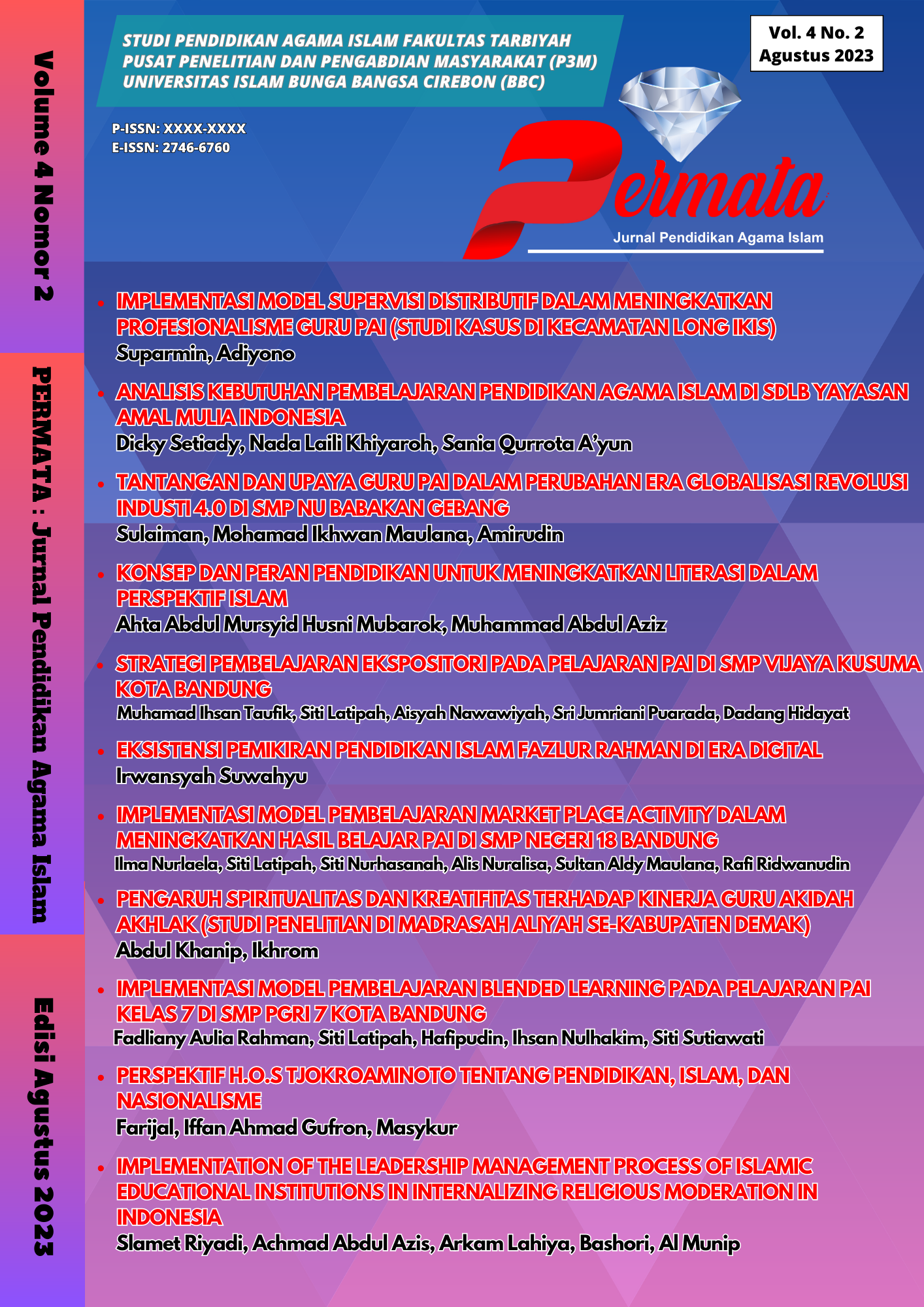
Implementasi Model Pembelajaran Blended Learning pada Pelajaran PAI Kelas 7 di SMP PGRI 7 Kota Bandung
DOI:
https://doi.org/10.47453/permata.v4i2.1264Keywords:
Model Pembelajaran, Blended Learning, Pelajaran PAIAbstract
This study aims to analyze the application of blended learning model in Islamic religious education class 7 at SMP PGRI 7 Bandung City. The research method used is a qualitative approach with a field research approach.
The results showed that Islamic religious education teachers at SMP PGRI 7 Bandung City applied a blended learning model in Islamic religious education lessons in grade 7 as a learning solution after the Covid-19 pandemic.
This model combines online and offline learning, which is varied with appropriate learning strategies and methods. The implementation of this learning model provides flexibility for students to learn independently, increases interaction between students and teachers, and expands access to learning resources. However, this learning model also has some disadvantages, such as the lack of student engagement during online learning and the gap in access to technology. Nevertheless, the implementation of blended learning model can be an effective solution to improve the quality of Islamic religious education learning at junior high school level.
Keyword: Learning Model; Blended Learning; Islamic Education Lessons.
Downloads
References
Abas, S., & Susetiyo, A. (2022). Redesain Pembelajaran Tematik PAI di Era Pendidikan 4.0. Jurnal Pendidikan Islam, 12(1), 52-60.
Abas, S., Lestari, E. W., Muti’aturrobbani, F., Yusuf, M., Khilmi, M., Maulani, R., & Hardiastuti, S. (2022). Improving Understanding of Islamic Cultural History Learning Through the Development of Video Blogging-Based Learning Media (Vlog). Action Research Journal Indonesia, 4(1), 28-41.
Afriantari, V. L., Haida, N., & Lasmana, M. I. (2022). Entrepreneurship Technology in Sharia Economic Perspective. ICOBBA_2021, 441-445.
Khozin, A. A., Pratama, F. A., Ridwan, M., Amin, N. M. F., & Lesmana, T. (2022). Inflation and the Stability of Islamic Finance. ICOBBA_2021, 404-409.
Marleni, E., Mustoip, S., & Sulkhah, S. (2024). Implementation of the Literacy Movement in Shaping Student Character in Elementary School. EduBase: Journal of Basic Education, 5(2), 120-130.
Munajim, A., Pratama, F. A., Ridwan, M., & Rohimah, I. (2022). The Operations of the Bank Wakaf Micro Indonesia with the Scheme for the Economic Empowerment of the People. ICOBBA_2021, 1-6.
Nasir, A., Busthomi, A. O., & Rismaya, E. (2022). Shariah Tourism Based on Local Wisdom: Religious, Income, Motivation, Demand and Value of Willingness to Pay (WTP). International Journal Of Social Science And Human Research, 5(08), 3811-3816.
Pratama, F. A., Ridwan, M., Yulianti, N., Ratnawati, R., Maulana, A., & Masitoh, S. I. (2022). Implementasi Persamaan Fungsi Non Linier Dalam Matematika Bisnis Pada Kehidupan Sehari-Hari. Change Think Journal, 1(03), 289-299.
Pratama, G. (2022). Comparative Study of The Empowerment of Zakat BAZNAS Indonesia and PPZ Malaysia. ICOBBA_2021, 212-216.
Putri, Y. D. S., Mustoip, S., Nisa, D. H., & Ramadhani, N. U. (2024). Implementation of Audiolingual Methods in Understanding Arabic Color Concepts in Class I SDIT Alif Mardiyah. JPS: Journal of Primary School, 1(2), 1-6.
Ridwan, M., Motik, D. P., & Nurwahid, H. I. (2022). Afzalur Rahman's Thinking Concept: Relevance with Worker Ethics According to Global Standards. ICOBBA_2021, 322-329.
Selasi, D., Agustiani, L. R., & Vidiati, C. (2022). Upaya Mengubah Pendapatan Usaha Mikro Kecil Menengah (UMKM) Melalui Digital Marketing. Jurnal Multidisiplin Madani, 2(3), 1247-1258.
Selasi, D., Munajim, A., & Komala, S. I. (2022). The Digitization of Islamic Philanthrophy In the Islamic Capital Market in Indonesia. ICOBBA_2021, 166-174.
Selasi, D., Munajim, A., & Komala, S. I. (2022). The Digitization of Islamic Philanthrophy In the Islamic Capital Market in Indonesia. ICOBBA_2021, 166-174.
Selasi, D., Muzayyanah, M., Tatmimah, I., Sari, F., & Indriyani, R. (2022). Contribution of Islamic Capital Market to National Capital Market. INCOME: Innovation of Economics and Management, 2(1), 1-7.
Selasi, D., Vidiati, C., & Munajim, A. (2022). Pertumbuhan Bank Syariah di ASEAN: Dalam Sejarah The Growth of Islamic Banks in ASEAN: In History. Ecobankers: Journal of Economy and Banking, 3(2), 157-171.
Selasi, D., Vidiati, C., & Munajim, A. (2022). Pertumbuhan Bank Syariah di ASEAN: Dalam Sejarah The Growth of Islamic Banks in ASEAN: In History. Ecobankers: Journal of Economy and Banking, 3(2), 157-171.
Selasi, D., Vidiati, C., & Sumarno, S. (2022). Pasar Menabung Saham Pada Pasar Modal Indonesia. Ecopreneur: Jurnal Ekonomi dan Bisnis Islam, 3(1), 68-77.
Selasi, D., Vidiati, C., & Tardjono, T. (2022). Sharia Capital Market: Securities Fatwa, Derivative Securities and Mechanisms. IJOBBA: International Journal of Bunga Bangsa Cirebon, 1(1), 1-24.
Selasi, D., Virdiati, C., Munajim, A., & Sujata, T. (2022). Kesejahteraan Masyarakat: Analisa Kualitatif Sistem Keuangan Komersial Islam-SIstem Keuangan Sosial Islam di Indonesia.
Stefanus, S., & Ridwan, M. (2022). Analisis Strategi Marketing Syariah Untuk Meningkatkan Omset Penjualan Pada Era Globalisasi Di Toko Emas Pantes Sindang Laut Kabupaten Cirebon. Change Think Journal, 1(01), 87-95.
Vidiati, C., Al-Ghozali, M. I., Faturrizky, I., Selasi, D., Munajim, A., & Tardjono, T. (2022). Effects of the Money Market and the Need for Knowledge of Interest Rates and the Foreign Exchange Market for Benefit: Evidence In Indonesia. IJOBBA: International Journal of Bunga Bangsa Cirebon, 1(1), 37-60.
Vidiati, C., Hendra, E., Selasi, D., & Sumarno, S. (2022). Menilik Tas’ ir Keadilan dan Maslahah. Ecopreneur: Jurnal Ekonomi dan Bisnis Islam, 3(1), 78-92.
Wartoyo, W., Haida, N., Mujab, S., & Umam, M. K. (2022). Sharia Marketing Model Pada Bisnis Laundry Syariah (Case Study Pada Zada Laundry Syariah Sumber Cirebon). PROFIT: Jurnal Kajian Ekonomi Dan Perbankan Syariah, 6(1).