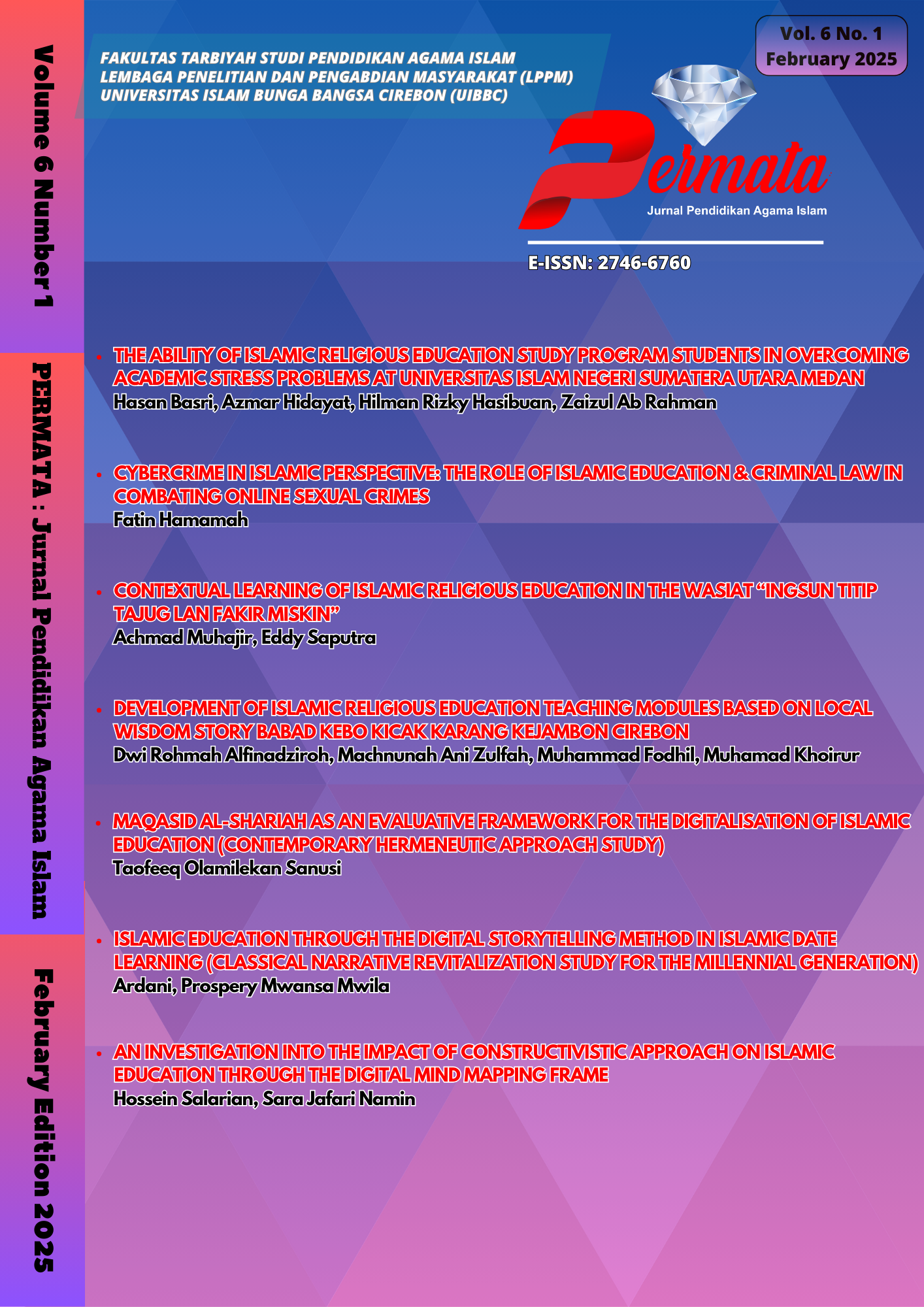
Cybercrime in Islamic Perspective: The Role of Islamic Education & Criminal Law in Combating Online Sexual Crimes
DOI:
https://doi.org/10.47453/permata.v6i1.3067Keywords:
Cybercrime, Islamic Education, Criminal Law, Online Sexual Crimes, PreventionAbstract
This study aims to examine the phenomenon of cybercrime, especially online sexual crimes (cybersex), from an Islamic perspective and the role of Islamic education and criminal law in overcoming it. Online sexual crimes are increasingly growing along with the rapid progress of information and communication technology, which raises new challenges in the fields of law and morality. In this context, Islamic education and the criminal law system have an important role in preventing and eradicating such acts.
This study uses a qualitative method with a descriptive analytical approach, collecting data from Islamic law sources and criminal law studies related to cybercrime at SMP Islam Plered Cirebon.
The results of the study indicate that Islamic education can provide a strong moral foundation in preventing the misuse of technology, while Islamic and state criminal law offer strict sanctions for perpetrators of cybersex. The implementation of both in society is expected to create better awareness and self-control among individuals.
The social implications of this study show the importance of integration between religious education and law in building a society that is aware of the negative impacts of technology. The role of families, educational institutions, and the government in providing education about the dangers of cybersex as well as strict law enforcement is needed to create a safe and responsible cyberspace. The results of this study have implications for the need to strengthen Islamic education and curriculum on digital ethics, reform the legal system, develop comprehensive prevention programs involving the role of parents, and increase digital legal literacy in society to deal with cybersex problems effectively.
Keywords: Cybercrime; Islamic Education; Criminal Law; Online Sexual Crimes; Prevention
Downloads
References
Ahmad, A., & Muslimah, M. (2021, December). Memahami Teknik Pengolahan Dan Analisis Data Kualitatif. In Proceedings of Palangka Raya International and National Conference on Islamic Studies (PINCIS) (Vol. 1, No. 1).
Akhuai, W., Nugraha, A. A., Lukitaningtyas, Y. K. R. D., Ridho, A., Wulansari, H., & Al Romadhona, R. A. (2022). Social capital of pancasila education in smart education with social media in cybercrime prevention in the industrial revolution era 4.0. Jurnal Panjar: Pengabdian Bidang Pembelajaran, 4(2), 283-442. https://doi.org/10.15294/panjar.v4i2.55047
Al-Ghazali, A. (1997). Ihya' Ulum al-Din (Rev. ed.). Dar al-Kutub al-Ilmiyyah.
Astuti, D. (2020). The Role of Islamic Education in Preventing Cybercrime Among Teenagers in Indonesia. International Journal of Islamic Education, 7(2), 88-99.
Bachiochi, P. D., & Weiner, S. P. (2010). Qualitative Data Collection and Analysis. Handbook of research methods in industrial and organizational psychology, 161-183.
Chang, L. Y. C. (2019). Criminological Perspectives on Cybercrime: Risk, Routine Activity, and Cybercrime. In Research handbook on transnational crime (pp. 327-343). Edward Elgar Publishing. https://doi.org/10.4337/9781784719449.00030
Creswell, J. W. (2021). Research Design: Qualitative, Quantitative, and Mixed Methods Approaches (4th ed.). SAGE Publications.
Djamal, S. F. (2019). Penanggulangan Kejahatan Dalam Perspektif Hukum Pidana Islam. Binamulia Hukum, 8(2), 217-230. https://doi.org/10.37893/jbh.v8i2.354
Drew, J. M. (2020). A Study of Cybercrime Victimisation and Prevention: Exploring the Use of Online Crime Prevention Behaviours and Strategies. Journal of Criminological Research, Policy and Practice, 6(1), 17-33. https://doi.org/10.1108/JCRPP-12-2019-0070
Duff, R. A. (2022). Punishment as Communication. Google Books.
Gardner, J. (2002). Book Review: Punishment, communication and community. Punishment & Society, 4(4), 496-499. https://doi.org/10.1177/146247450200400407
Giddens, A. (2015). Sociology (6th ed.). Polity Press.
Goffman, E. (2023). The Presentation of Self in Everyday Life. In Social theory re-wired (pp. 450-459). Routledge.
Hassan, A. (2022). The Role of Islamic Education in Preventing Cybercrime in the Digital Era. Journal of Islamic Education and Social Studies, 15(2), 122-134.
Hawdon, J. (2021). Cybercrime: Victimization, perpetration, and techniques. American Journal of Criminal Justice, 46(6), 837-842. https://doi.org/10.1007/s12103-021-09652-7
Khalish, M. A., & Widiasmara, N. (2023). Preventing Child Grooming: Sex Education from Islamic Perspective. Proceedings of the International Conference on Islamic Social Sciences and Humanities. http://hdl.handle.net/123456789/53542
Mahbubi, M., Huda, A. A. S. B., & Bilqis, A. (2025). Sexual Violence Prevention Strategies in Faith-Based Educational Institutions: A Case Study in Grobogan. Indev: Literasi Media Dakwah dan Pengembangan Masyarakat, 4(1), 1-16.
Nadriana, L., & Sukmana, P. (2022). Exploring the Applicability of Common Law Principles in Combating Cybercrime in Indonesia: An Analysis of Current Legal Framework and Challenges. International Journal of Cyber Criminology, 16(2), 192-204.
Nurhayati, S., Musa, S., Boriboon, G., Nuraeni, R., & Putri, S. (2021). Community Learning Center Efforts to Improve Information Literacy in The Community for Cyber-Crime Prevention During a Pandemic. Journal of Nonformal Education, 7(1), 32-38. https://doi.org/10.15294/jne.v7i1.26883
Onwuegbuzie, A. J., Leech, N. L., & Collins, K. M. (2010). Innovative Data Collection Strategies in Qualitative Research. Qualitative report, 15(3), 696-726.
Shah, M. H., Jones, P., & Choudrie, J. (2019). Cybercrimes Prevention: Promising Organisational Practices. Information Technology & People, 32(5), 1125-1129. https://doi.org/10.1108/ITP-10-2019-564
Tatarinova, L. F., Shakirov, K. N., & Tatarinov, D. V. (2016). Criminological Analysis of Determinants of Cybercrime Technologies. International Electronic Journal of Mathematics Education, 11(5), 1127-1134.
Teguh, M. T. S., Wulan, T. N., & Juansah, D. E. (2023). Teknik Pengumpulan Data Kuantitatif Dan Kualitatif Pada Metode Penelitian. Pendas: Jurnal Ilmiah Pendidikan Dasar, 8(3), 5962-5974. https://doi.org/10.23969/jp.v8i3.12005