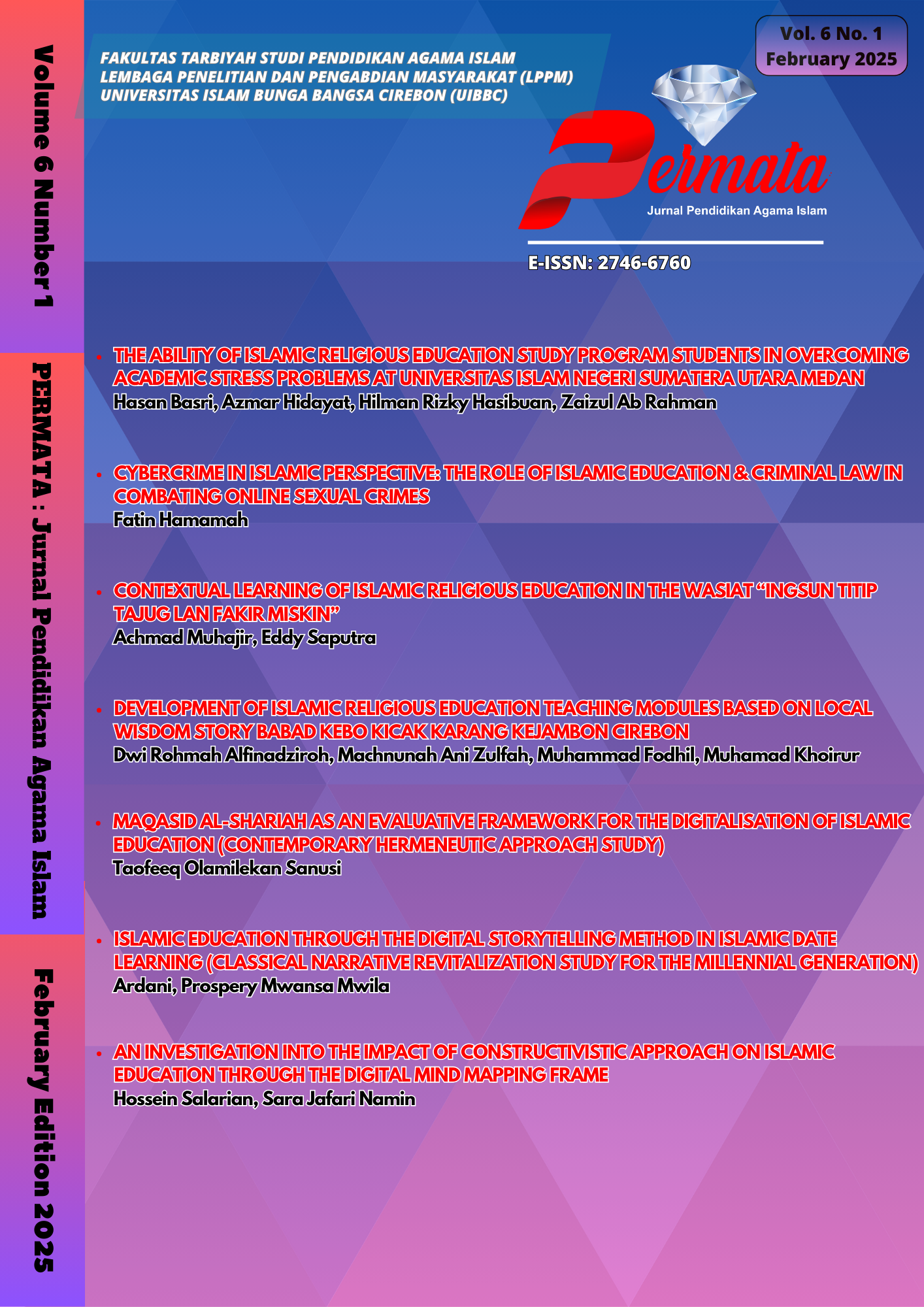
Maqasid Al-Shariah as an Evaluative Framework for the Digitalisation of Islamic Education
(Contemporary Hermeneutic Approach Study)
DOI:
https://doi.org/10.47453/permata.v6i1.3114Keywords:
Maqasid Al-Shariah, Evaluative Framework, Digitalization of Islamic EducationAbstract
This research examines the dualism of challenges in digitalising Islamic education - the need to adopt technology to improve competitiveness versus the fear of erosion of traditional values and Islamic identity. Using a qualitative method with a contemporary hermeneutic approach and literature research type, this study conducts a comprehensive analysis of primary (classical works of Al-Ghazali, Al-Shatibi, Ibn Ashur) and modern (Jasser Auda, Mohammad Hashim Kamali, Ahmad Al-Raysuni) sources, as well as relevant secondary sources. The research results identified four models of Maqasid Al-Shariah reinterpretation in the context of the digitalisation of Islamic education: teleological-contextual (Jasser Auda), systemic-holistic (Mohammad Hashim Kamali), integration-interconnection (Amin Abdullah), and transformative-reconstructive (Ebrahim Moosa and Tariq Ramadan). The research also found that Maqasid Al-Shariah provides five main evaluative dimensions that can be applied in assessing the digitalisation of Islamic education: protection of religion (hifz al-din), protection of the soul (hifz al-nafs), protection of the intellect (hifz al-'aql), protection of offspring (hifz al-nasl), and safety of property (hifz al-mal).
Keywords: Maqasid Al-Shariah; Evaluative Framework; Digitalization of Islamic Education
Downloads
References
Abou El Fadl, K. (2014). Reasoning With God: Reclaiming Shari’ah in the Modern Age. Rowman & Littlefield.
Abubakari, M.S. (2024). The Digital Frontier within Islamic Education: Research Gaps Overview in Digital Competence. Journal of Computing Research and Innovation, 9(2), 317-331. https://doi.org/10.24191/jcrinn.v9i2.435
Adiyono, A., & Anshor, AM (2024). Islamic Character Education in the Era of Industry 5.0: Navigating Challenges and Embracing Opportunities. Al-Hayat: Journal of Islamic Education, 8(1), 287-304. https://doi.org/10.35723/ajie.v8i1.493
Al-Qaradawi, Y. (2019). Maqasid Al-Shariah and the Challenges of Modernity (4th ed.). International Institute of Islamic Thought.
Al-Raysuni, A. (2013). Maqasid al-Maqasid al-Ghayat al-'Ilmiyyah wa al-'Amaliyyah li Maqasid al-Shari 'ah . Beirut: al-Shabkah al-'Arabiyyah li al-Abhas wa al-Nashr.
Arkoun, M. (2003). Rethinking Islam Today. The Annals of the American Academy of Political and Social Science, 588(1), 18-39. https://doi.org/10.1177/00027162035880010
Auda, J. (2019). Maqasid Al-Shariah as Philosophy of Islamic Law: A Systems Approach. International Institute of Islamic Thought.
Auda, J. (2020). Maqasid Al-Shariah: A Beginner’s Guide (Revised ed.). International Institute of Islamic Thought.
Auda, J. (2022). Maqasid Methodology for Re-Envisioning Islamic Higher Education. Journal of Contemporary Maqasid Studies, 1(1), 31-58.
Bethel, A. L. (2024). Understanding the Impact of Instructional Methods on Student Achievement in Religious Studies: A Qualitative Study in the Bahamas (Doctoral dissertation, Concordia University Chicago).
Darus, M., Junus, M., Husin, NKM, Abidin, NHZ, Khadzali, NR, & Ma'dan, M. (2016). Ethical Governance through Maqasid Shariah Perspective: A Conceptual Framework.
Diana, A., Azani, M. Z., & Mahmudulhassan, M. (2024). The Concept and Context of Islamic Education Learning in the Digital Era: Relevance and Integrative Studies. Prophetic: Journal of Islamic Studies, 25(01), 33-44. https://doi.org/10.23917/profetika.v25i01.4239
Duderija, A. (Ed.). (2015). Maqasid al-Shari’a and Contemporary Reformist Muslim Thought: An Examination. Springer.
Hendawi, M., & Qadhi, S. (2024). Digital Literacy-Based Learning in Islamic Education. Ar-Fachruddin: Journal of Islamic Education, 1(1), 45-58. https://doi.org/10.7401/j19t2q81
Hoerudin, CW, Syafruddin, S., Mayasari, A., Arifudin, O., & Lestari, S. (2023). E-Learning as A Learning Media Innovation Islamic Education. QALAMUNA: Journal of Education, Social, and Religion, 15(1), 723-734. https://doi.org/10.37680/qalamuna.v15i1.4466
Ibrahim, A., & Razak, SH (2019). Maqasid Al-Shariah Versus a Textualist Approach in The Solution of Contemporary Issues. International Journal of Islamic Thought, 15, 35-47.
Ibrahim, AH, Rahman, NNA, & Saifuddeen, SM (2018). Maqasid Al-Shariah as A Complementary Framework for Conventional Bioethics: Application in Malaysian Assisted Reproductive Technology (ART) Fatwa. Science and Engineering Ethics, 24, 1493-1502. https://doi.org/10.1007/s11948-017-9963-6
Ibrahim, AH, Rahman, NNA, Saifuddeen, SM, & Baharuddin, M. (2019). Maqasid Al-Shariah Based Islamic Bioethics: A Comprehensive Approach. Journal of Bioethical Inquiry, 16(3), 333-345. https://doi.org/10.1007/s11673-019-09902-8
Ibrahim, M., Islam, S., Zohriah, O., & Azid, M. (2024). Addressing Contemporary Ethical and Moral Issues Through Islamic Education. Journal on Islamic Studies, 1(1), 36-51. https://doi.org/10.35335/694rde54
Kamali, MH (2015). What Everyone Needs to Know About Sharia. Academia.
Kamali, MH (2019). Maqasid Al-Shariah Made Simple. International Institute of Islamic Thought.
Kamali, MH (2020). Al-Maqasid Al-Shari'ah. Ijtihad and Civilization Renewal. International Institute of Islamic Thought.
Lahsasna, A. (2011). Maqasid Al Shariah in Islamic Economics and Finance. In Second Islamic Seminar on Islamic thought (ISoIT2 2011).
Malik, M. (2015, October). Al-Maqasid Al-Shariah (the Comprehensive Objective of Shari’ah). In Paper presented on Penang Institute-G25 Forum, “Maqasid Syariah in a Constitutional Democracy (Vol. 31).
Mardiana, D., Razaq, AR, & Umiarso, U. (2020). Development of Islamic Education: The Multidisciplinary, Interdisciplinary and Transdisciplinary Approaches. Al-Hayat: Journal of Islamic Education, 4(1), 58-68. https://doi.org/10.35723/ajie.v4i1.97
Masruchin, M. (2024). Maqasid Syariah in Presenting Contemporary Interpretation. Journal Khafi: Journal of Islamic Studies, 3(1), 12-16.
Mohadi, M., & Tarshany, Y. (2023). Maqasid Al-Shari’ah and the Ethics of Artificial Intelligence: Contemporary Challenges. Journal of Contemporary Maqasid Studies, 2(2), 79-102.
Moosa, E., & Ramadan, T. (Eds.). (2023). Islam and the Future of Digital Education. Oxford University Press.
Morris, R. J., & Cahill, M. (2017). A Study of How We Study: Methodologies of School Library Research 2007 through July 2015. School Library Research, 20.
Mufron, A., Fata, TH, & Rohmani, A. (2024). The Concept of Islamic Education Today in the Challenges of the Social Media Era. Al-Hijr: Journal of Adullearn World, 3(1).
Muhammad, S., & Razak, SA (2022). A Gadamerian-Maqasid Hermeneutical Approach for Islamic Studies in The Digital Era. International Journal of Islamic Thought, 21, 95-113.
Munir, MM, & Saputra, R. (2022). Human Resource Management Perspective of Al Maqasid Al Šar’iyyah in Islamic Education Institutions. Journal of World Science, 1(12), 1183-1195. https://doi.org/10.58344/jws.v1i12.150
Musolin, MH, Serour, ROH, Siregar, M., Hamid, SA, Ismail, A., Huda, M., & Rohim, MA (2024, February). Developing Personalised Islamic Learning in Digital Age: Pedagogical and Technological Integration for Open Learning Resources (OLR). In International Congress on Information and Communication Technology (pp. 11-25). Singapore: Springer Nature Singapore. https://doi.org/10.1007/978-981-97-3305-7_2
Niaz, N.S. (2024). Reform of Muslim Family Law in Perspective of Maqasid Al-Shariah. RADEN INTAN: Proceedings on Family and Humanity, 1(1), 1-10.
Perrier, A., & Salah, C. (2024). Islamic Studies and the Digital Humanities. Introduction. Revue Des Mondes Musulmans Et De La Méditerranée, (156 (2/2024)). https://doi.org/10.4000/130g0
Quraishi-Landes, A. (2014). Islamic Constitutionalism: Not Secular. Not Theocratic. Not Impossible. Rutgers JL & Religion, 16, 553.
Rahman, F. (2017). Islam & Modernity: Transformation of an Intellectual Tradition (Vol. 15). University of Chicago Press.
Rohman, H. (2018). Maqasid Al-Shari’ah of the Shafi’i School and Its Urgency in Contemporary Ijtihad. Journal of Islamic Law, 16(2), 188-204. https://doi.org/10.28918/jhi.v16i2.1737
Sahin, A. (2023). Digital Islamic Education: A Critical Analysis of Research Trends 2018-2023. Oxford Center for Islamic Studies.
Sanusi, M. (2024). Transforming Islamic Education in the Digital Age: Challenges and Opportunities for the Young Generation. Attractive: Innovative Education Journal, 6(3), 206-215. https://doi.org/10.51278/aj.v6i3.1479
Sardar, Z. (Ed.). (2019). The Postnormal Times Reader. International Institute of Islamic Thought.
Setiawan, A. (2019). Conceptual of Blended Learning as Islamic Education Study Program Learning Reform Action in Digital Era 4.0. SYAMIL: Journal of Islamic Education, 7(2), 137-148. https://doi.org/10.21093/sy.v7i2.1827
Suyatno, S., Jumintono, J., & Mardapi, D. (2021). Technological Pedagogical Content Knowledge (TPACK) of Islamic Education Teachers in Indonesia: Challenges and opportunities. International Journal of Educational Research, 109, 101807.
Syihab, MB (2023). A Critical Study of Jasser Auda’s Thinking in the Book “Maqasid Al-Shariah as Philosophy of Islamic Law: A Systems Approach”. AN NUR: Journal of Islamic Studies, 15(1), 114-136. https://doi.org/10.37252/annur.v15i1.455
Tajudeen, A.L., & Lawal, M.A. (2023). Application of Maqasid al-Shariah-Based Public Policy Framework in SDGs Policies: Poverty Eradication (SDG 1) as a Case Study. In Public Policy’s Role in Achieving Sustainable Development Goals (pp. 78-95). IGI Global. https://doi.org/10.4018/978-1-6684-8903-1
Ubaidillah, MB, & Laili, AN (2021). The Theory of Maqosid Sharia: The Perspective of Modern and Contemporary Ulema. RED COAT: Journal of Law and Ahwal al-Syakhsiyyah, 1(1), 1-15.
Yamakami, T. (2015, July). A Framework for Capturing the Cultural Characteristics of Digital Natives. In 2015 17th International Conference on Advanced Communication Technology (ICACT) (pp. 628-633). IEEE. https://doi.org/10.1109/ICACT.2015.7224873
Zainuddin, A., Mamat, A., & Hassan, MS (2023). Operationalizing Maqasid Dimensions for Educational Evaluation: A Conceptual Framework. International Journal of Islamic Education, 10(1), 32-51.
Zayd, N. H. A. (2004). Rethinking The Qur’ân: Towards A Humanistic Hermeneutics. Utrecht, The Netherlands: Humanistics University Press.
Zulqarnain, M., & Al-Azhari, MA (2020). Addressing Essential Dimensions of an Ideal Teacher’s Relationship with Students in the Light of Islamic Educational Philosophy. Pakistan Journal of Multidisciplinary Research, 1(1), 84-93.