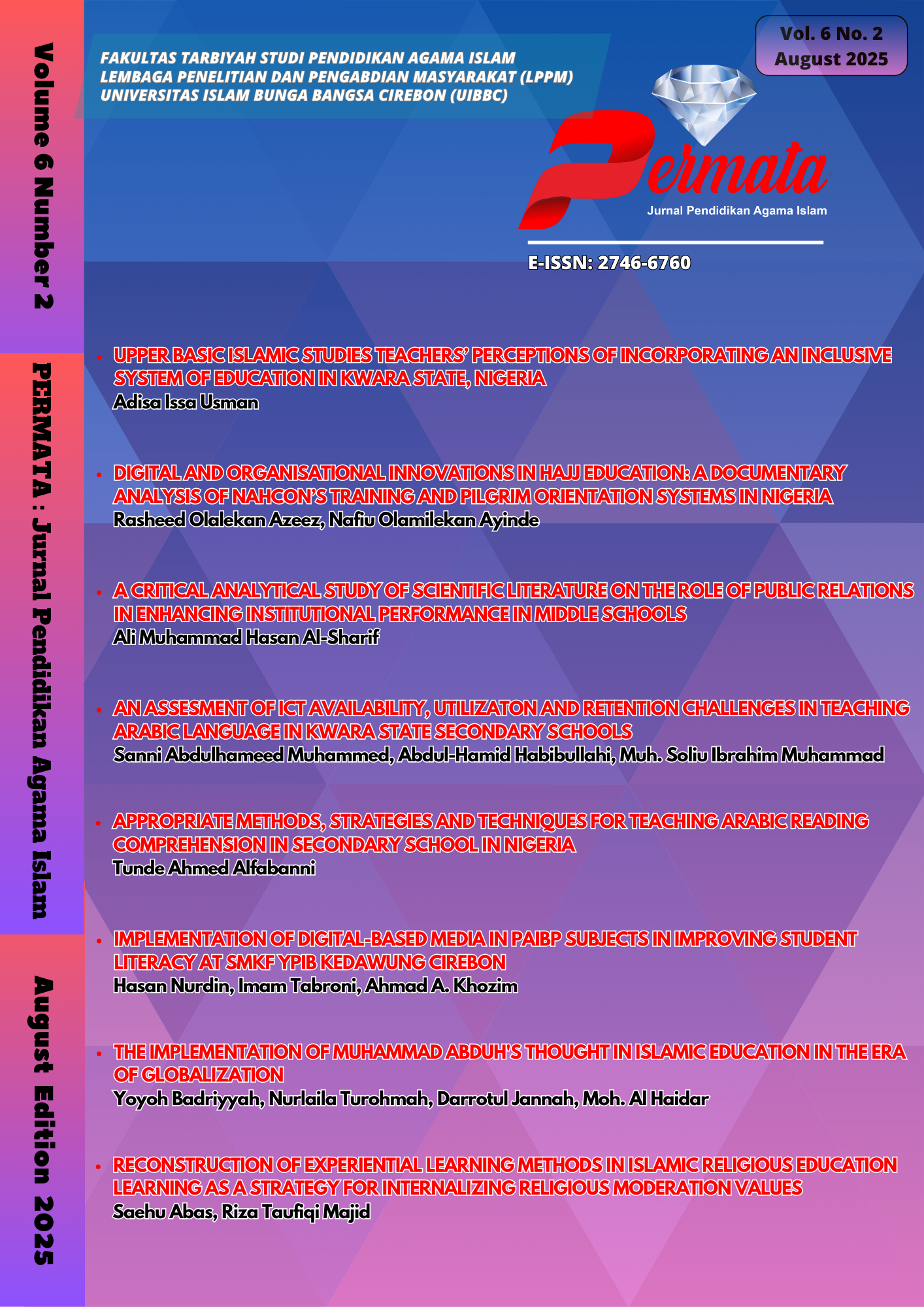
Upper Basic Islamic Studies Teachers’ Perceptions of Incorporating an Inclusive System of Education in Kwara State, Nigeria
DOI:
https://doi.org/10.47453/permata.v6i2.3804Keywords:
Islamic Studies Teachers, Inclusive Education, Upper Basic Schools, Teacher AttitudeAbstract
Inclusive education has become a central focus of global educational reforms aimed at ensuring equitable learning opportunities for all learners, including those with disabilities. In Nigeria, efforts to integrate inclusive practices into basic education continue to face implementation challenges; therefore, understanding teachers’ perceptions is essential for effective policy execution. This study investigated upper basic Islamic Studies teachers’ perceptions, knowledge, and attitudes toward the incorporation of an inclusive education system in Kwara State, Nigeria. A descriptive survey design was employed, and 200 Islamic Studies teachers were selected through multi-stage, stratified, cluster, and purposive sampling techniques. Data were collected using an adapted questionnaire titled Islamic Studies Teachers’ Perceptions of Inclusive Education (ISTPIE). The instrument’s reliability was confirmed through a test–retest procedure, yielding a coefficient of 0.86. Descriptive statistics (percentage, mean, and standard deviation) were used to answer the research questions, while independent t-test and ANOVA were applied to test the hypotheses at the 0.05 significance level. Findings indicated that teachers exhibited moderate levels of perception, knowledge, and attitude toward inclusive education. Results further showed no significant differences in teachers’ perceptions based on gender or educational qualification. The study concludes that although Islamic Studies teachers possess basic awareness of inclusive education, concerns persist regarding its feasibility due to systemic constraints. This research contributes empirical evidence to support policy dialogue on teacher preparedness and highlights the need for targeted professional development to enhance teachers’ capacity for effective, inclusive classroom practices.
Downloads
References
Akrim, A. (2020). MENJADI GENERASI PEMIMPIN, Apa Yang Dilakukan Sekolah?
Akrim, A. E. (2021). The inclusive education: an Islamic education perspective. Journal of Psychology and Education, 58(4), 791-799.
Akrim, M., & Harfiani, R. (2019). Daily Learning Flow of Inclusive Education for Early Childhood. Utopia y Praxis Latinoamericana, 24(Extra6), 132–141.
Amaireh, S. (2017). Teachers' attitudes towards the inclusion of children with special educational needs in Jordanian ordinary schools (Doctoral dissertation, University of Nottingham).
Aron, L., & Loprest, P. (2012). Disability and the education system. The future of Children, 97-122.
Awajiokinor, E. M., Orlunga, B. G. & Echeonwu. J. (2024). Invigorating inclusive education in Nigerian school system: technological implementations for teacher training institutions. International Journal of Research in Education and Sustainable Development, 4(7), 105-113.
Bocharova, O. (2020). Inclusive education in Ukraine: Current status and problems in development. Edukacja Elementarna w Teorii i Praktyce, 15(3(57)), 81–93. https://doi.org/10.35765/eetp.2020.1557.06
Buford, S., & Casey, L. (2012). Attitude of teachers regarding their preparedness to teach students with special needs. Delta Journal of Education, 2(2), 16-30.
Bunza, M. U. (2020). Islamic/muslim education in Africa: From North to West Africa. In The Palgrave Handbook of African Education and Indigenous Knowledge (pp. 127-150). Cham: Springer International Publishing.
Cornelius-Ukpepi, B.U. & Opuwari, O. S. (2019). Determinants of effective implementation of inclusive education at the basic education level in Nigeria. British Journal of Education, 7(8), 34-44.
Dapudong, R. C. (2014). Teachers’ knowledge and attitude towards inclusive education: Basis for an enhanced professional development program. International Journal of Learning & Development, 4(4), 1-24.
Kwon J.E. & Park, S.Y. (2011). Advanced organic optoelectronic materials: Harnessing excited-state intramolecular proton transfer (ESIPT) process. Advanced Materials, 23(32), 15-42.
Lawal, O. T., David, M. O., & Baniyaminu, O. H. (2025). Promoting quality inclusive education for children with disabilities in Nigerian basic schools through research data integration. Journal of Early Childhood Development and Education, 2(1), 7-12. https://doi.org/10.58723/junior.v2i1.282
Musyoka, M. M., & Clark, M. D. (2017). Teachers’ perceptions of individualised education program (IEP) goals and related services. Journal of Developmental and Physical Disabilities, 29(1), 5-23.
Nur, F. S. (2019). Revitalisasi Parenting Luqman (Usaha Progresif Membangun Ketahanan Nasional Melalui Keluarga). Al-I’jaz: Jurnal Kewahyuan Islam, 1(1), 66.
Olufunke, A. M., & Oluremi, O. F. (2014). Inclusive education and the development of Nigerian communities. International Journal of Academic Research in Progressive Education and Development, 3(1), 28-40.
Oluwawumi, O. O., & Akinbile, S. O. (2024). Teachers’ knowledge, perception and attitude towards the implementation of individualised educational plans in building an inclusive culture in Nigeria. International Journal of Childhood and Development Disorders, 5(1), 6-12.
Omede, A. A., & Momoh, D. (2016). Teacher preparation for inclusive education of persons with special needs in Nigeria: The challenges and solutions. European Journal of Educational and Development Psychology, 4(1), 34-40
Orlunga, B. G. & Alikor, O. (2023). Inclusive education and policy implementation for educational development in the 21st century. European Journal of Education Studies, 10(11), 245-257.
Rose, R., Narayan, J., Matam, S., & Reddy Sambram, P. (2021). A comparison of provision and access to inclusive education for children with disabilities in a metropolitan city and a rural district in Telangana State, India. Education Sciences, 11(3), 111. https://doi.org/10.3390/educsci11030111
Singh, S., Kumar, S., & Singh, R. K. (2020). A study of attitude of teachers towards inclusive education. Shanlax International Journal of Education, 9(1), 189-197. https://doi.org/10.34293/education.v9i1.3511
Tod, J., Castle, F., & Blamires, M. (2013). Individual Education Plans Implementing Effective Practice. Routledge.
Tomori, A. A. (2020). Teachers' Attitude Towards Inclusive Classroom in Kwara State, Nigeria. I-Manager's Journal on School Educational Technology, 15(4), 25.
Yusuf, M. Y. (2012). Pendidikan Islam Inklusif-Multikultural Dalam Perspektif Teori Gestalt. Jurnal Pendidikan Islam, I, 1–18.